
How to use this information: UV is different from heat is most useful when it is read with location, update time and the surrounding forecast rather than treated as an isolated number. For everyday planning, compare the current value with the next few hours. When safety is involved, confirm conditions with the responsible meteorological or public-safety authority.
What not to assume: A consumer forecast simplifies a changing atmosphere. UV index: using the number for sun-exposure awareness should support a decision, not create false precision about an exact street, exact minute or guaranteed outcome.
UV is different from heat
A cool day can still have meaningful ultraviolet exposure, and a hot day is not automatically a high-UV day. Temperature measures thermal conditions, while UV concerns ultraviolet radiation.
Check UV information separately from temperature when planning time outdoors.
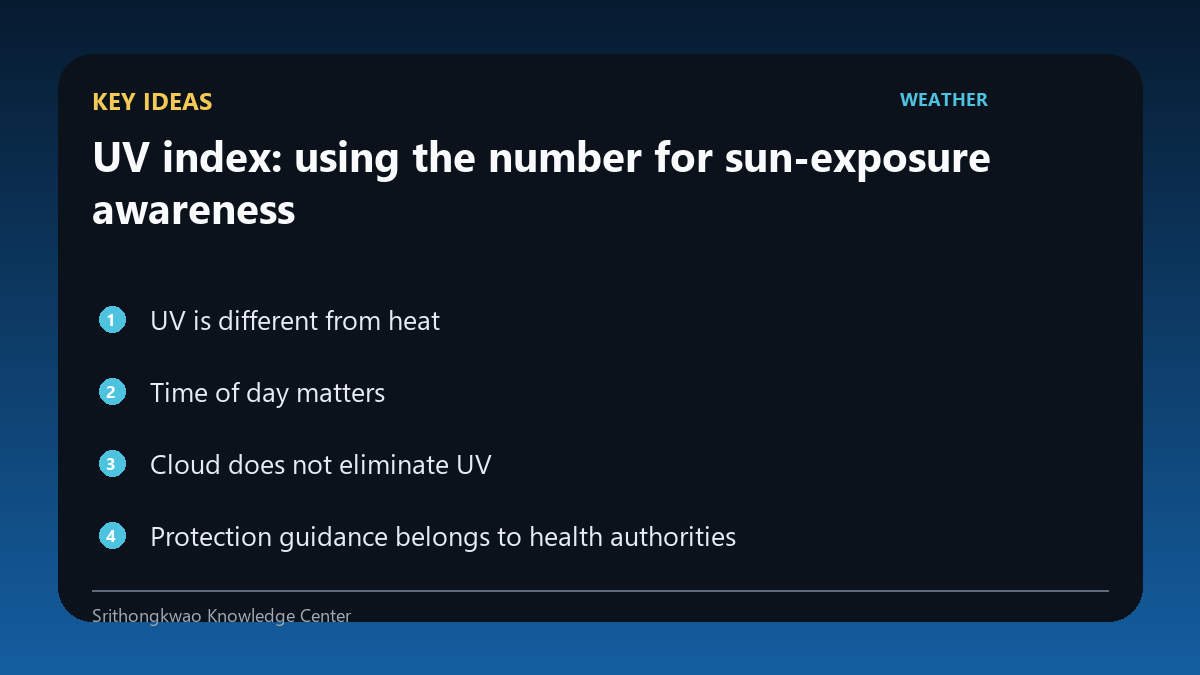
Time of day matters
UV generally changes with the sun's position, so exposure potential can vary substantially through the day.
If your weather product provides hourly UV, use the time-specific value rather than applying the daily maximum to every hour.
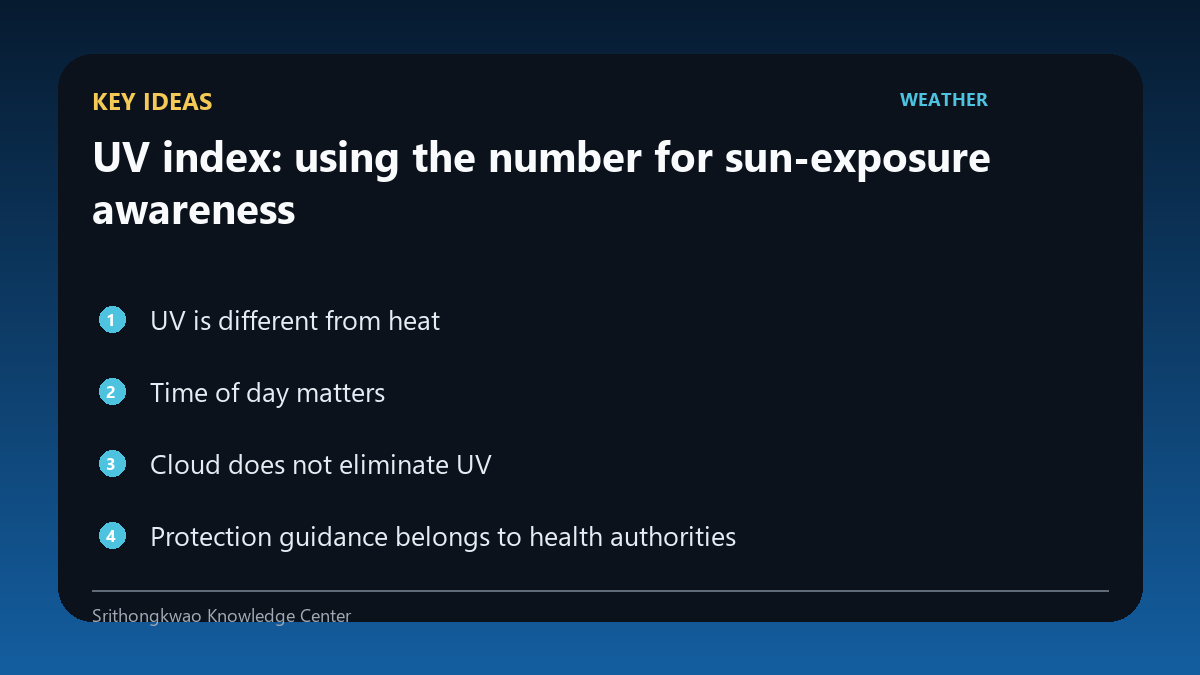
Cloud does not eliminate UV
Cloud can reduce ultraviolet radiation, but the effect varies with cloud type and conditions. A cloudy-looking sky is not a reliable reason to ignore sun-protection guidance.
Use the UV value and public-health advice instead of judging exposure only by visible brightness.
Protection guidance belongs to health authorities
Appropriate protective actions can depend on UV level, skin exposure, duration and personal factors. Health agencies publish guidance designed for those decisions.
Use the app to notice UV conditions and follow the responsible health authority for protective recommendations.
Reflection and environment matter
Water, sand, snow and other surfaces can affect exposure. Shade and built environments also change direct sunlight.
Consider the real environment where you will spend time rather than treating the index as a complete personal dose measurement.
Common mistakes to avoid
- Using temperature as a substitute for UV.
- Assuming clouds block all UV.
- Treating the index as a personalized medical assessment.
Practical checklist
- Check the UV value.
- Consider time outdoors.
- Account for the environment.
- Use official protection guidance.
- Do not rely on visible brightness alone.
Frequently asked questions
Can UV be high on a cool day?
Yes. UV and air temperature measure different environmental conditions.
Does cloud mean UV is zero?
No. Ultraviolet radiation can still reach the surface through cloud.
Is the UV index a personal dose?
No. It is an environmental index, not an individualized measurement of absorbed radiation.