How to use this information: The atmosphere starts from imperfect information is most useful when it is read with location, update time and the surrounding forecast rather than treated as an isolated number. For everyday planning, compare the current value with the next few hours. When safety is involved, confirm conditions with the responsible meteorological or public-safety authority.
What not to assume: A consumer forecast simplifies a changing atmosphere. Weather forecast uncertainty: why predictions change should support a decision, not create false precision about an exact street, exact minute or guaranteed outcome.
The atmosphere starts from imperfect information
Forecast models begin with observations from many sources, but the atmosphere cannot be measured at every point. Small initial uncertainties can grow as time passes.
Treat a forecast as an estimate with confidence that depends on lead time and weather type.
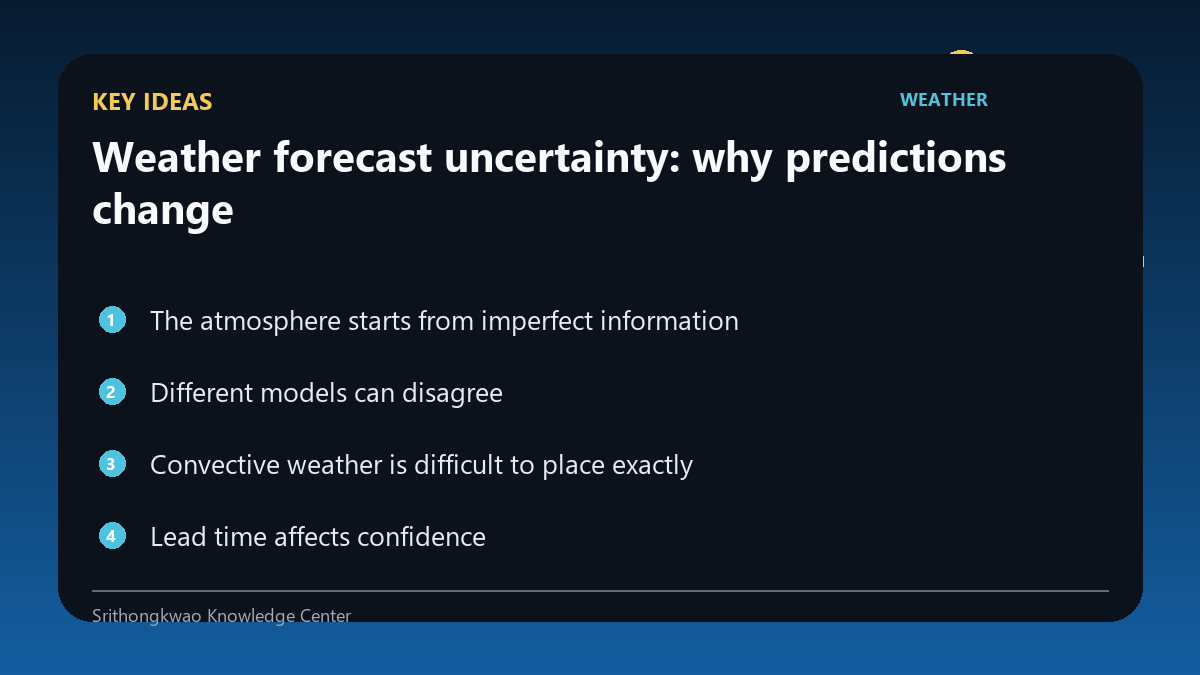
Different models can disagree
Forecast systems use different methods, resolutions and assumptions. Their predicted storm tracks, rain bands or temperatures can therefore differ.
A consumer app may combine sources, but disagreement is a reason to avoid false precision rather than to pick the most dramatic result.
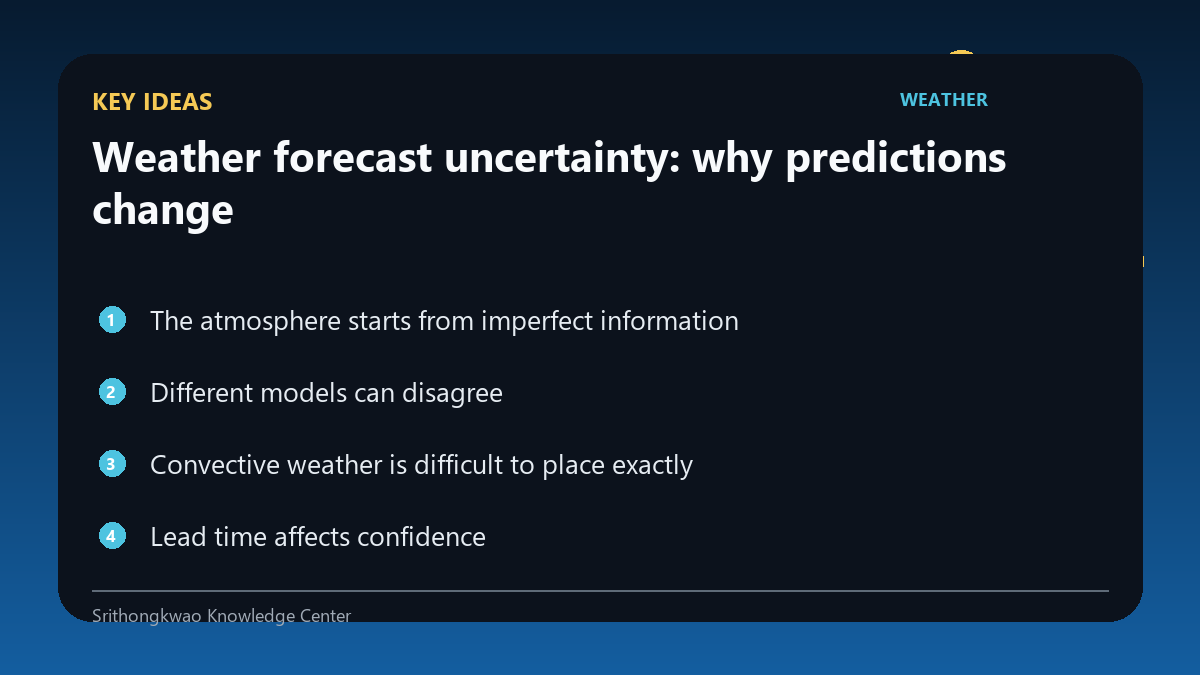
Convective weather is difficult to place exactly
Showers and thunderstorms can develop on small spatial and time scales. A city-level forecast can correctly identify a stormy environment while missing the exact street or minute.
For active storms, use short-term official observations, radar and warnings where available.
Lead time affects confidence
Tomorrow's broad pattern is usually more constrained than the exact details many days away. As new observations arrive, later forecasts can shift.
Use long-range information for flexible planning and increase detail closer to the event.
Good decisions include a margin
A plan can acknowledge uncertainty instead of pretending the forecast is exact. Buffers, backup locations and alternate travel times reduce dependence on one prediction.
The more severe the consequence of being wrong, the more conservative your decision should be.
Common mistakes to avoid
- Demanding exact minute-level certainty days ahead.
- Choosing one model only because it shows the preferred outcome.
- Calling every forecast update a failure.
Practical checklist
- Consider lead time.
- Watch the trend across updates.
- Use buffers.
- Check official nowcasting for storms.
- Match caution to consequence.
Frequently asked questions
Why did tomorrow's rain time change?
New observations and evolving model guidance can shift the predicted timing.
Does disagreement mean forecasts are useless?
No. It indicates uncertainty that should be included in planning.
Are thunderstorms harder to pinpoint?
Yes. Individual convective cells can be difficult to predict precisely in time and location.