How to use this information: Location determines the times is most useful when it is read with location, update time and the surrounding forecast rather than treated as an isolated number. For everyday planning, compare the current value with the next few hours. When safety is involved, confirm conditions with the responsible meteorological or public-safety authority.
What not to assume: A consumer forecast simplifies a changing atmosphere. Sunrise and sunset times: useful context for weather and daily planning should support a decision, not create false precision about an exact street, exact minute or guaranteed outcome.
Location determines the times
Sunrise and sunset vary with latitude, longitude, date and time zone. Travelling to another region changes the values even on the same calendar day.
Confirm the selected location before using the times for a trip, photography session or outdoor schedule.
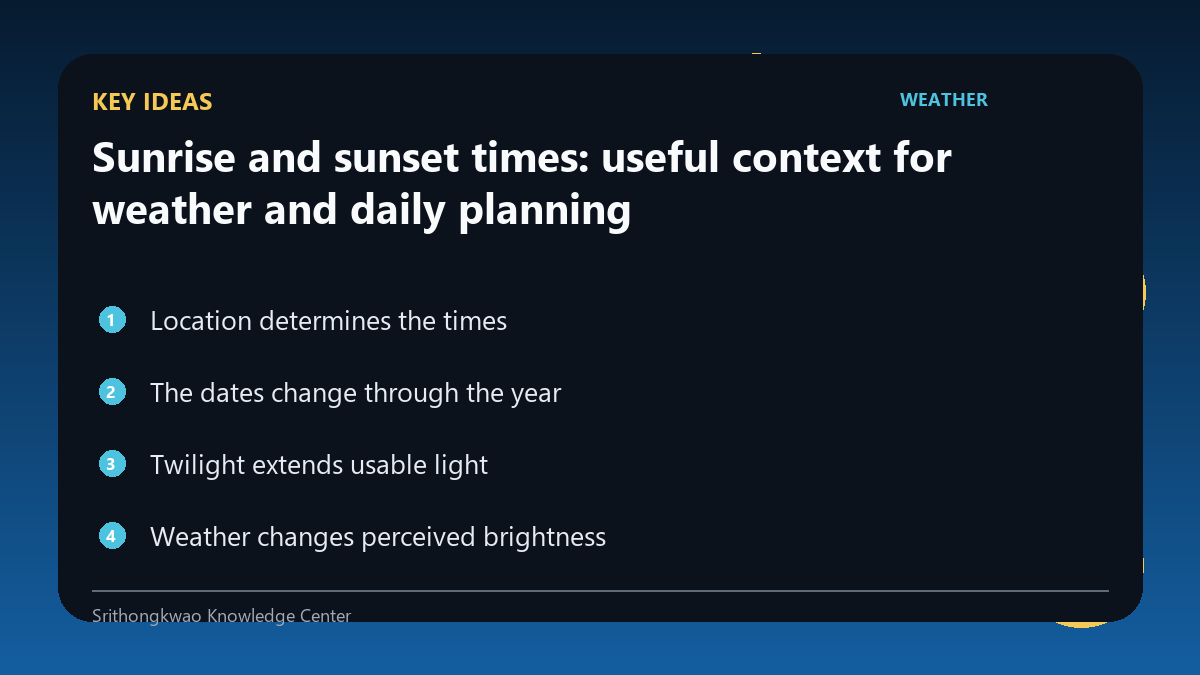
The dates change through the year
Day length varies seasonally, especially farther from the equator. The daily change may be small but accumulates over weeks and months.
Use the value for the actual date instead of reusing an old screenshot.
Twilight extends usable light
There is often meaningful ambient light before sunrise and after sunset. Different definitions of twilight describe the sun's position below the horizon.
If exact light level matters, use a dedicated twilight source rather than assuming sunset equals immediate darkness.
Weather changes perceived brightness
Cloud, rain, haze and terrain can make conditions darker earlier or brighter later than a simple astronomical time suggests.
For photography or visibility, combine sun times with cloud and local horizon conditions.
Safety planning needs a margin
Outdoor travel, trails and work can become harder as light fades, especially where terrain or infrastructure is challenging.
Plan a buffer instead of scheduling a safety-critical finish exactly at sunset.
Common mistakes to avoid
- Assuming sunset means instant darkness.
- Using times for the wrong location or date.
- Ignoring terrain and cloud.
Practical checklist
- Verify location and date.
- Allow for twilight.
- Consider cloud cover.
- Plan a safety margin.
- Refresh after travel across time zones.
Frequently asked questions
Why is it still light after sunset?
Twilight continues after the sun passes below the horizon.
Do clouds change the official sunset time?
No. The astronomical time stays the same, but perceived brightness can change.
Why do sunrise times differ between cities?
Longitude, latitude, date and time zone all affect the local time of sunrise.