How to use this information: Read several hours together is most useful when it is read with location, update time and the surrounding forecast rather than treated as an isolated number. For everyday planning, compare the current value with the next few hours. When safety is involved, confirm conditions with the responsible meteorological or public-safety authority.
What not to assume: A consumer forecast simplifies a changing atmosphere. Hourly weather forecasts: how to read the trend should support a decision, not create false precision about an exact street, exact minute or guaranteed outcome.
Read several hours together
One hourly row is a snapshot of an expected period. The sequence before and after it reveals whether temperature is rising, rain risk is building, wind is strengthening or conditions are settling.
For planning, look at a window of several hours rather than selecting the single row closest to your appointment.
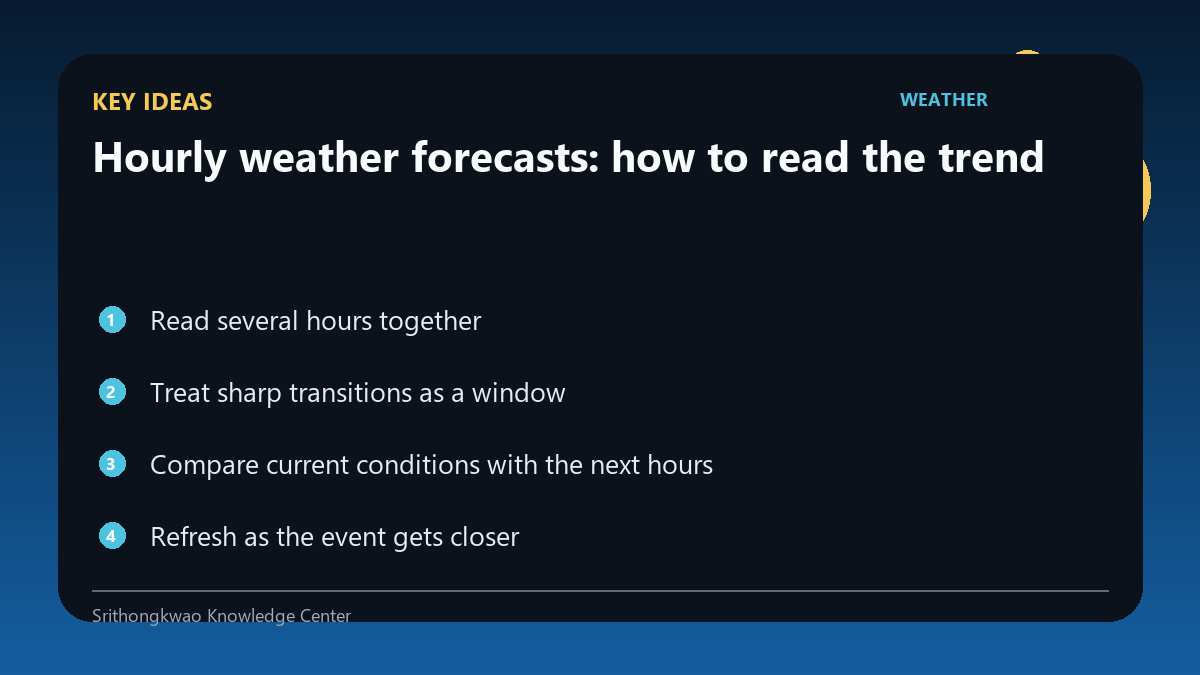
Treat sharp transitions as a window
Forecast tables can show a large change between adjacent hours because continuous atmospheric change has been summarized into fixed time slots. The actual transition may happen somewhat earlier or later.
If rain or wind appears suddenly in the table, build a time buffer instead of assuming the exact displayed hour is guaranteed.
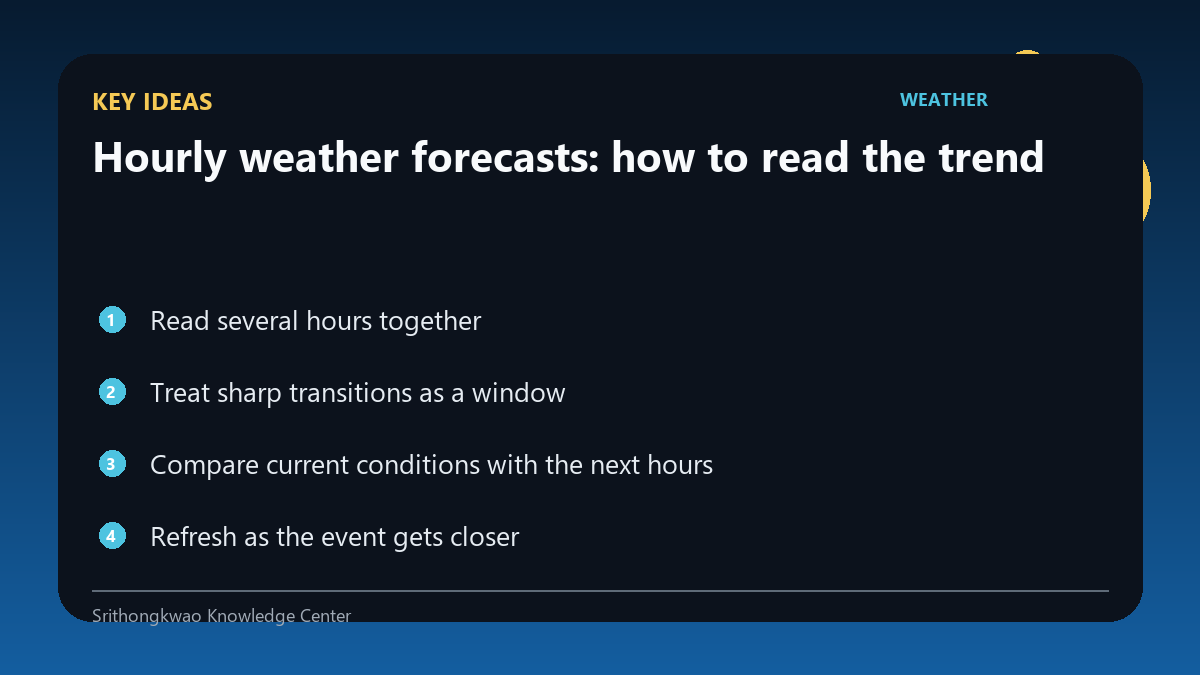
Compare current conditions with the next hours
The current panel tells you what is happening now or very recently, while the hourly forecast tells you what is expected next. Comparing the two helps you notice whether a forecast change may already be starting.
If direct local weather clearly differs from the expected trend, refresh and use official short-term information where the decision is important.
Refresh as the event gets closer
New observations and model updates can shift timing, especially for showers and thunderstorms. An hourly forecast viewed in the morning may not be the best available information by late afternoon.
Recheck near departure or event time rather than relying on an old screenshot.
Match detail to consequence
Hourly data is excellent for ordinary travel, errands and outdoor plans, but safety-critical operations may need official or specialist forecasts.
The more costly or dangerous a wrong forecast would be, the more sources and safety margin you should use.
Common mistakes to avoid
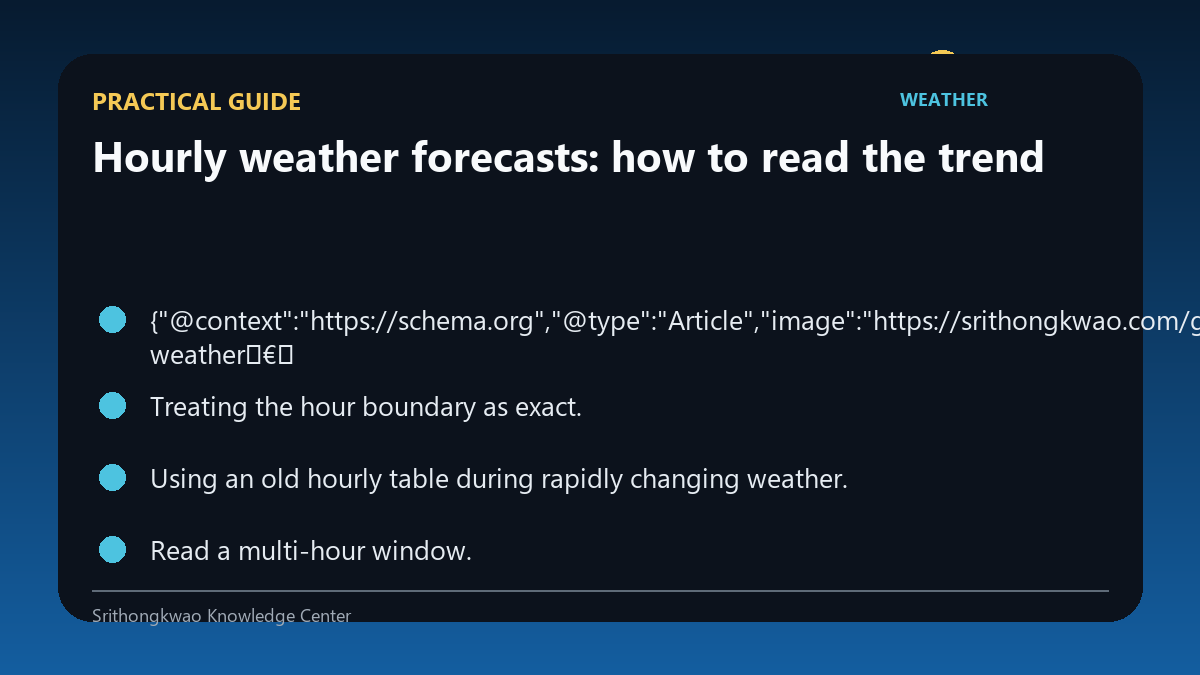
- Planning around one isolated hour.
- Treating the hour boundary as exact.
- Using an old hourly table during rapidly changing weather.
Practical checklist
- Read a multi-hour window.
- Check update time.
- Compare current conditions.
- Allow timing margin.
- Use official warnings when hazards matter.
Frequently asked questions
Does the weather change exactly on the hour?
No. Hourly rows are convenient forecast intervals, not physical boundaries.
How often should I refresh?
Refresh when your decision gets closer or when conditions are changing quickly.
Why can the timing shift?
New observations and evolving weather can change the expected timing of showers, storms and fronts.