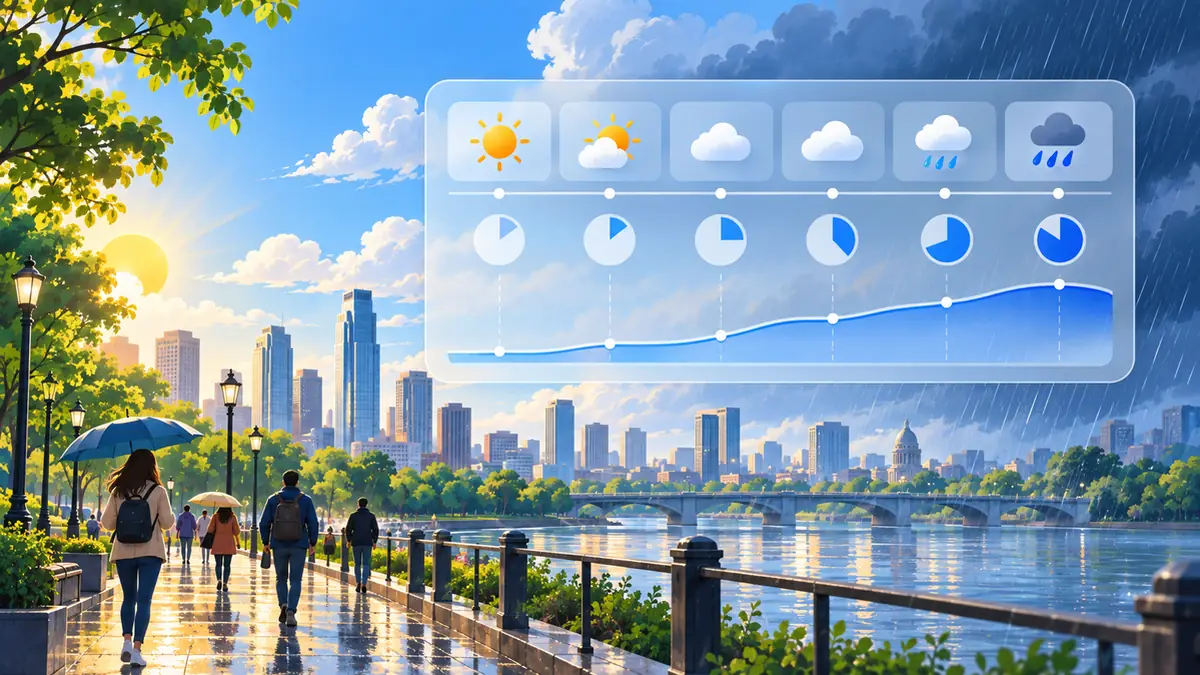
How to use this information: Probability is not a clock is most useful when it is read with location, update time and the surrounding forecast rather than treated as an isolated number. For everyday planning, compare the current value with the next few hours. When safety is involved, confirm conditions with the responsible meteorological or public-safety authority.
What not to assume: A consumer forecast simplifies a changing atmosphere. Rain probability: how to interpret the percentage should support a decision, not create false precision about an exact street, exact minute or guaranteed outcome.
Probability is not a clock
A precipitation probability describes likelihood for a location and forecast period according to the provider's method. It does not say that rain begins when the percentage reaches a particular number.
Check the associated hour or day and read the sequence of probabilities rather than waiting for a single threshold.
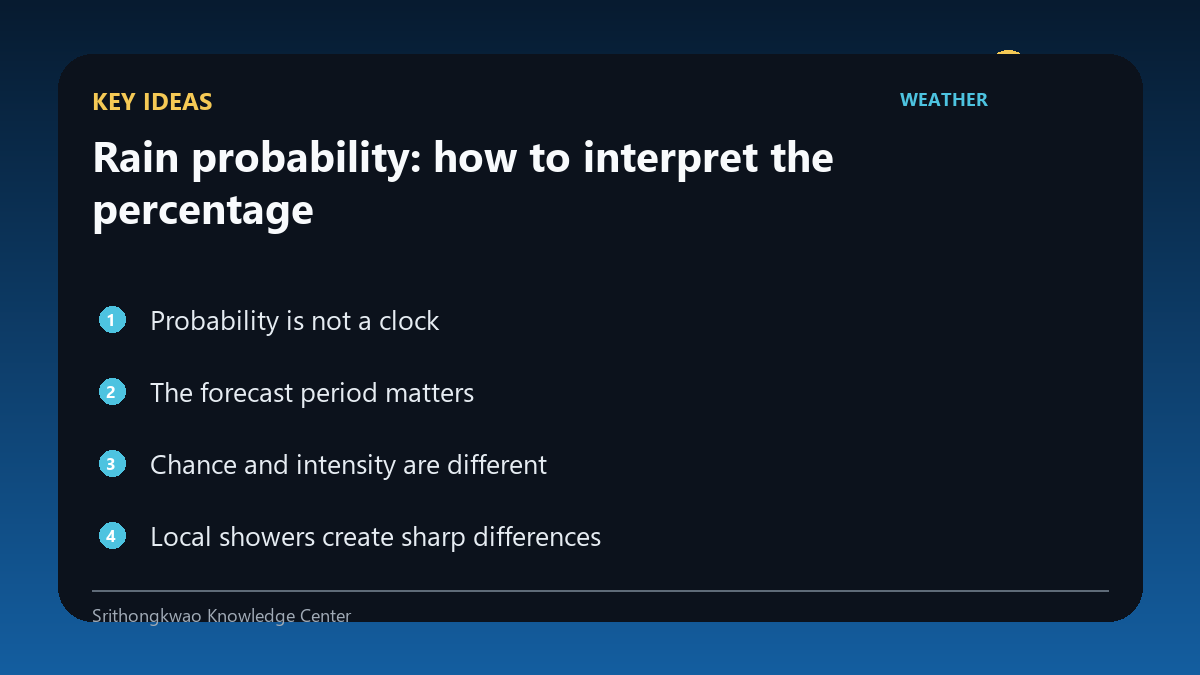
The forecast period matters
A daily probability covers a much longer interval than an hourly probability. Longer windows give more opportunity for precipitation to occur at some point.
For an event at a specific time, use the hourly forecast instead of applying the daily percentage to every hour.
Chance and intensity are different
Probability answers whether precipitation may occur; it does not by itself say how heavy or long-lasting it will be. A high chance can refer to light rain, while a lower chance can still involve a strong local shower.
Where available, read rainfall amount, intensity, storm information and warnings separately.
Local showers create sharp differences
Convective showers can affect one part of a city while another stays dry. A forecast grid summarizes spatial uncertainty that your exact street may not match.
When rain is nearby, combine the forecast with local observation and official radar or nowcasting where available.
Use probability according to consequence
The same forecast can lead to different choices for a short walk, an outdoor wedding or equipment that must stay dry. Planning should reflect the cost of being wrong.
For low-consequence activities, accept more uncertainty. For safety or expensive operations, seek more detailed official information.
Common mistakes to avoid
- Reading 40 percent as meaning it will rain for 40 percent of the hour.
- Assuming higher probability automatically means heavier rain.
- Ignoring whether the number is hourly or daily.
Practical checklist
- Check the time window.
- Read the trend across hours.
- Look for rainfall amount or intensity.
- Consider local radar when relevant.
- Match your decision to the consequence.
Frequently asked questions
Does 100 percent mean rain all day?
No. It indicates very high confidence that precipitation occurs in the forecast period, not necessarily continuous rain.
Can it rain when the app shows a low chance?
Yes. Low probability is not zero probability.
Why can nearby areas get different rain?
Showers and storms can be localized within the forecast area.