
How to use this information: What a rainfall amount represents is most useful when it is read with location, update time and the surrounding forecast rather than treated as an isolated number. For everyday planning, compare the current value with the next few hours. When safety is involved, confirm conditions with the responsible meteorological or public-safety authority.
What not to assume: A consumer forecast simplifies a changing atmosphere. Rainfall amount: reading millimetres without confusing them with probability should support a decision, not create false precision about an exact street, exact minute or guaranteed outcome.
What a rainfall amount represents
A precipitation amount is an estimated accumulation over a stated time window, often shown in millimetres. The value belongs to the forecast location or grid and does not guarantee that every nearby point receives exactly the same total.
Always identify the time period attached to the amount before comparing values.
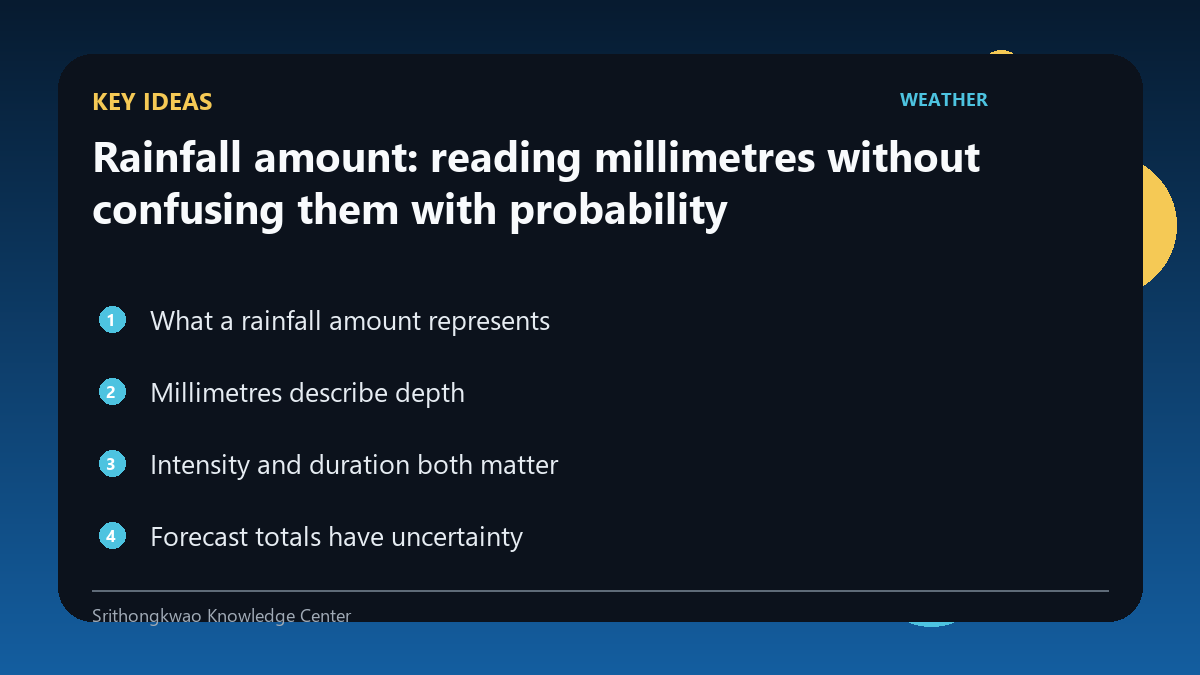
Millimetres describe depth
One millimetre of rainfall corresponds to a one-millimetre depth if water were spread evenly over a flat surface without runoff or absorption. Real landscapes drain, absorb and channel water differently.
Use the number as a standardized rainfall measure, not as a direct prediction of water depth on a road.
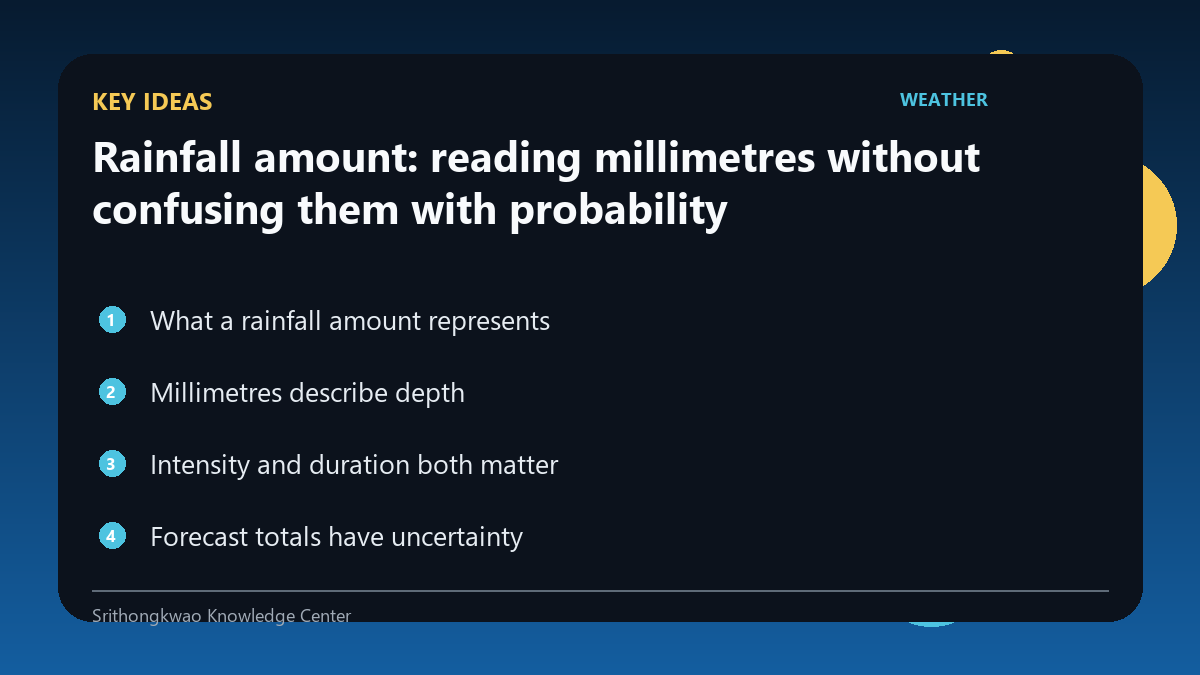
Intensity and duration both matter
The same total can arrive gently over many hours or quickly in a short burst. Those patterns can have very different impacts on drainage, visibility and local flooding.
If impacts matter, look for hourly distribution, storm information and official warnings rather than only the daily total.
Forecast totals have uncertainty
Rain bands and storms can shift, causing actual accumulation to differ substantially over short distances. Forecast totals are estimates that can change as new data arrives.
Refresh closer to the event and compare with official observations or radar during active rain.
Flood risk is more than rainfall total
Flooding depends on rainfall intensity, soil saturation, drainage capacity, rivers, terrain, upstream conditions and infrastructure. A consumer rainfall number cannot summarize all of those factors.
When flood risk is possible, follow official flood and emergency information instead of treating a millimetre threshold as a guarantee.
Common mistakes to avoid
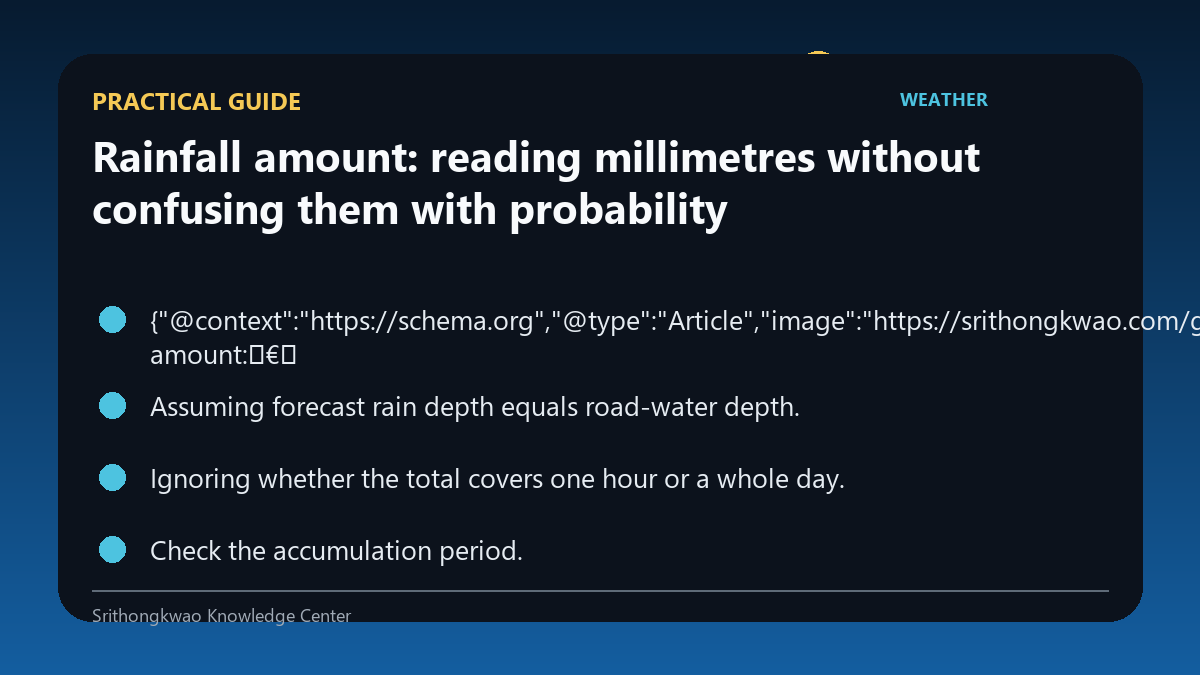
- Confusing millimetres with probability.
- Assuming forecast rain depth equals road-water depth.
- Ignoring whether the total covers one hour or a whole day.
Practical checklist
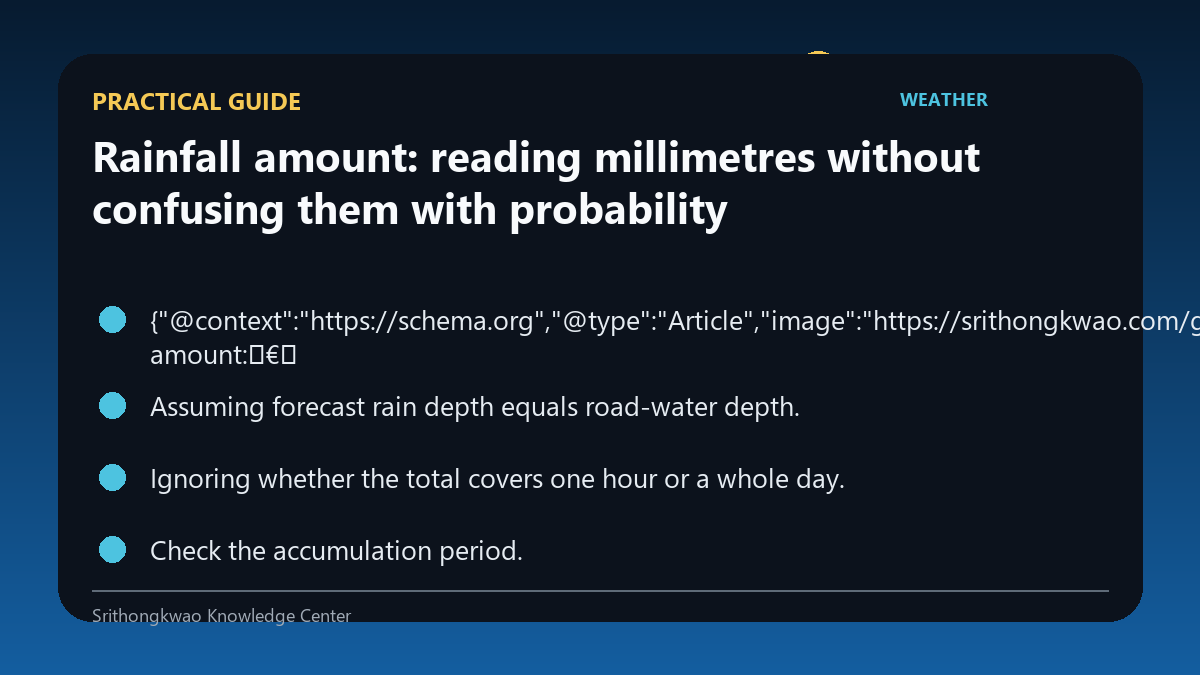
- Check the accumulation period.
- Compare hourly and daily totals.
- Look at intensity and storm context.
- Refresh during active weather.
- Use official flood information for safety.
Frequently asked questions
Is 10 mm always heavy rain?
Not necessarily. Impact depends strongly on how quickly it falls and local conditions.
Why can measured totals differ nearby?
Rainfall can vary sharply over short distances, especially in showers and thunderstorms.
Does a forecast amount guarantee that total?
No. It is an estimate that may change as the forecast updates.