How to use this information: Look beyond the maximum temperature is most useful when it is read with location, update time and the surrounding forecast rather than treated as an isolated number. For everyday planning, compare the current value with the next few hours. When safety is involved, confirm conditions with the responsible meteorological or public-safety authority.
What not to assume: A consumer forecast simplifies a changing atmosphere. Hot weather: reading forecast information for safer planning should support a decision, not create false precision about an exact street, exact minute or guaranteed outcome.
Look beyond the maximum temperature
The daily high shows the expected peak but not how many hours remain hot or whether overnight cooling is limited.
Use the hourly forecast to understand the duration of heat as well as the peak.
Apparent temperature adds context
Humidity and other factors can make heat feel more stressful than air temperature alone. Feels-like values can help describe the environment.
Treat them as environmental estimates and use official health guidance for protective actions.
Direct sun increases exposure
People in full sun can experience greater heat load than a shaded air-temperature reading suggests.
Plan shade and timing based on the real environment, not only the forecast number.
Activity and vulnerability matter
Strenuous work, age, health conditions, medication and acclimatization can change individual risk.
A consumer weather app cannot personalize those factors. Seek appropriate health guidance when needed.
Official heat alerts take priority
Public-health and meteorological agencies may issue heat advisories or warnings based on local criteria and expected impacts.
Follow those messages, especially for vulnerable people and prolonged outdoor exposure.
Common mistakes to avoid
- Using the daily high as a personal medical threshold.
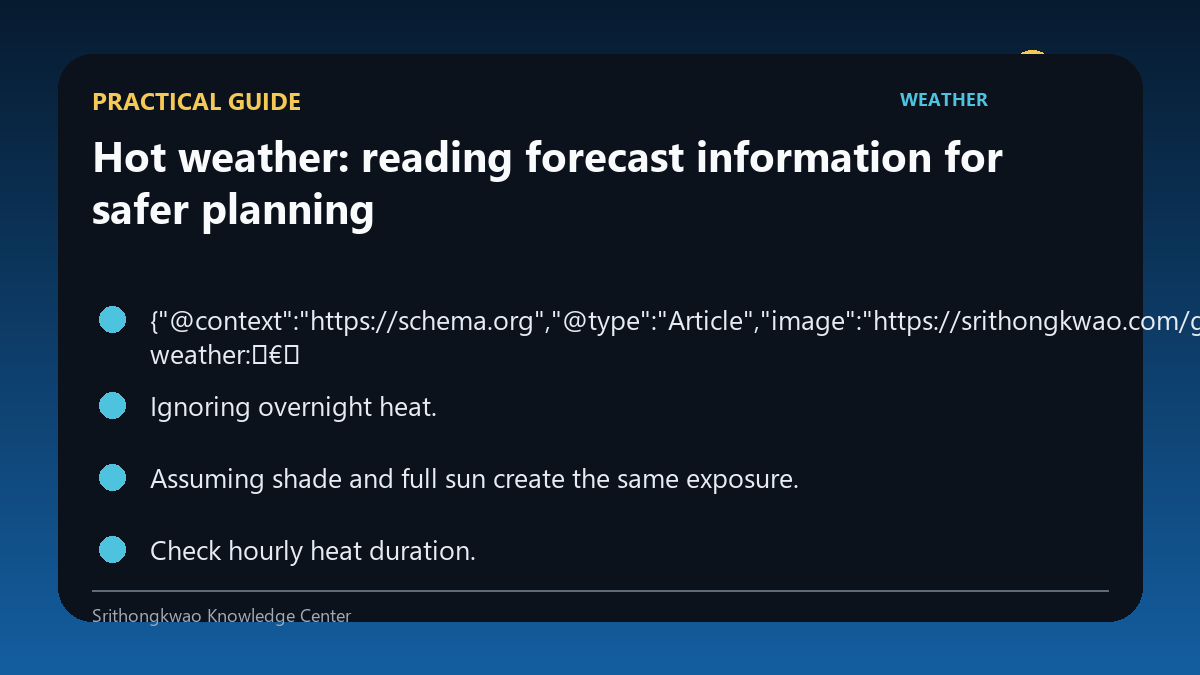
- Ignoring overnight heat.
- Assuming shade and full sun create the same exposure.
Practical checklist
- Check hourly heat duration.
- Read humidity or feels-like context.
- Plan shade and water access.
- Reduce exposure when advised.
- Follow official heat alerts.
Frequently asked questions
Is the daily high enough to judge heat risk?
No. Duration, humidity, sun, activity and personal factors also matter.
Can the app tell me if I will get heat illness?
No. It provides environmental information, not a personal medical diagnosis.
Why does overnight temperature matter?
Limited overnight cooling can prolong heat exposure and reduce recovery.