User control: Find what data is collected should be explained in plain language before a user is expected to make a privacy or permission choice. A permission can often be denied, limited or changed later through browser or Android settings.
Data-minimization principle: How to read a privacy policy without getting lost should use only the information needed for the stated purpose. Users should avoid sharing secrets or unrelated personal information simply because a form, screenshot or upload makes it technically possible.
Find what data is collected
Look for account details, uploaded content, device information, location, advertising data and logs.
The policy should distinguish important categories rather than relying only on vague phrases.
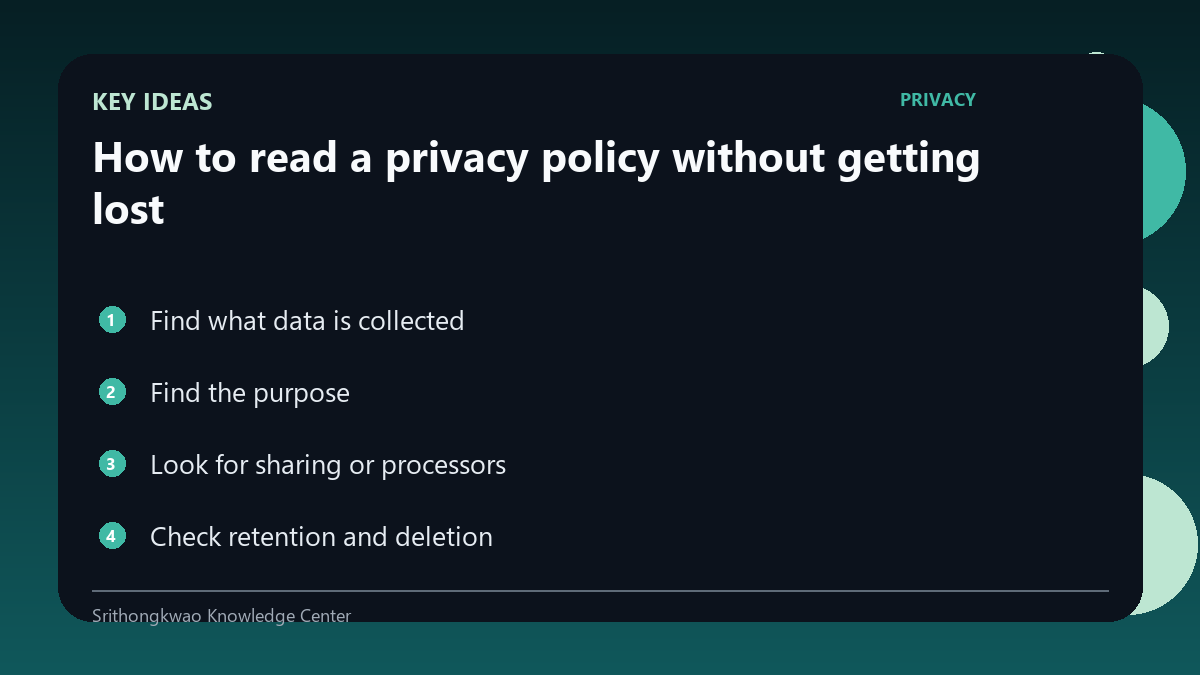
Find the purpose
Each meaningful data category should have an understandable reason such as delivering a feature, security or advertising.
A purpose explains why the data exists in the system.
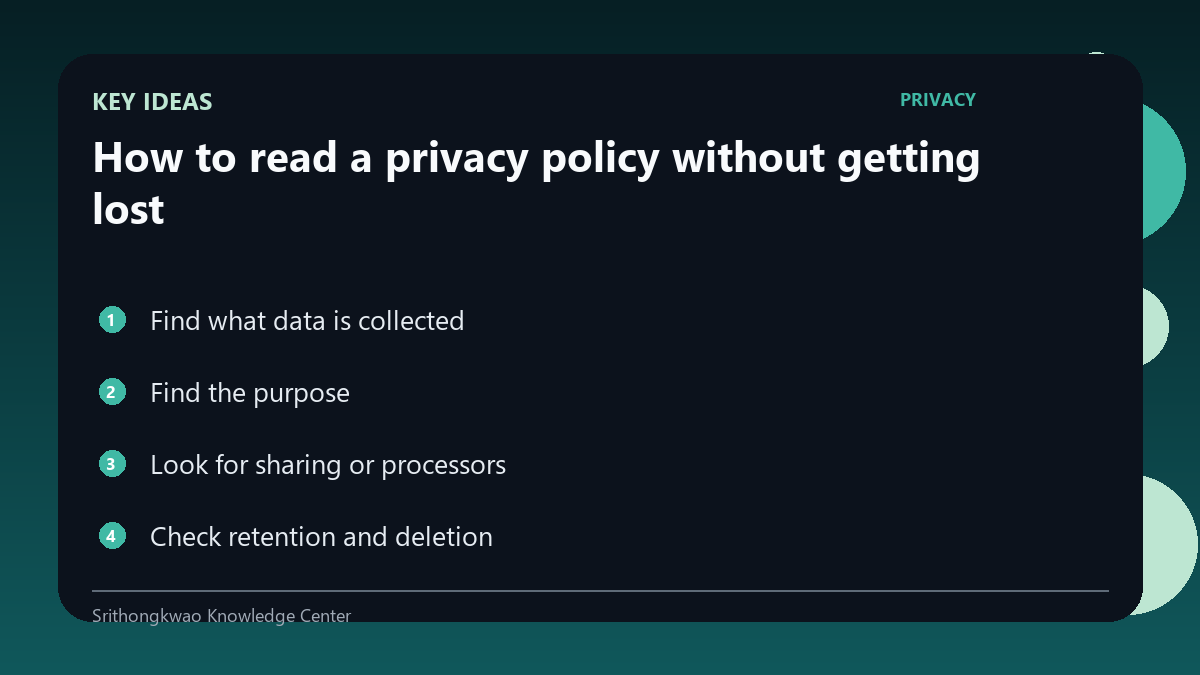
Look for sharing or processors
Hosting, analytics, advertising and other providers may receive data as part of service delivery.
The notice should explain the relevant roles at a useful level.
Check retention and deletion
Look for how long information is kept or what determines the retention period.
Find the route for deletion or privacy requests.
Find user controls and contact
Permissions, consent settings and support channels help users exercise choices.
A policy without any contact route is harder to act on.
Common mistakes to avoid
- Reading only the first paragraph.
- Ignoring third-party sections.
- Assuming delete means the same thing for every data type.
Practical checklist
- Identify data categories.
- Match each to a purpose.
- Check sharing.
- Check retention.
- Find contact and controls.
Frequently asked questions
Do I need to understand every legal term?
Focus first on concrete data, purpose, sharing, retention and choices.
Why check third parties?
They can participate in processing required to deliver the service.
Where should I ask a question?
Use the official privacy or contact route published by the service.