
User control: Servers need network routing should be explained in plain language before a user is expected to make a privacy or permission choice. A permission can often be denied, limited or changed later through browser or Android settings.
Data-minimization principle: IP addresses and network data in web services should use only the information needed for the stated purpose. Users should avoid sharing secrets or unrelated personal information simply because a form, screenshot or upload makes it technically possible.
Servers need network routing
Internet communication requires addressing information so responses can return to the requesting device or network.
Web servers commonly receive IP and connection information as part of normal operation.
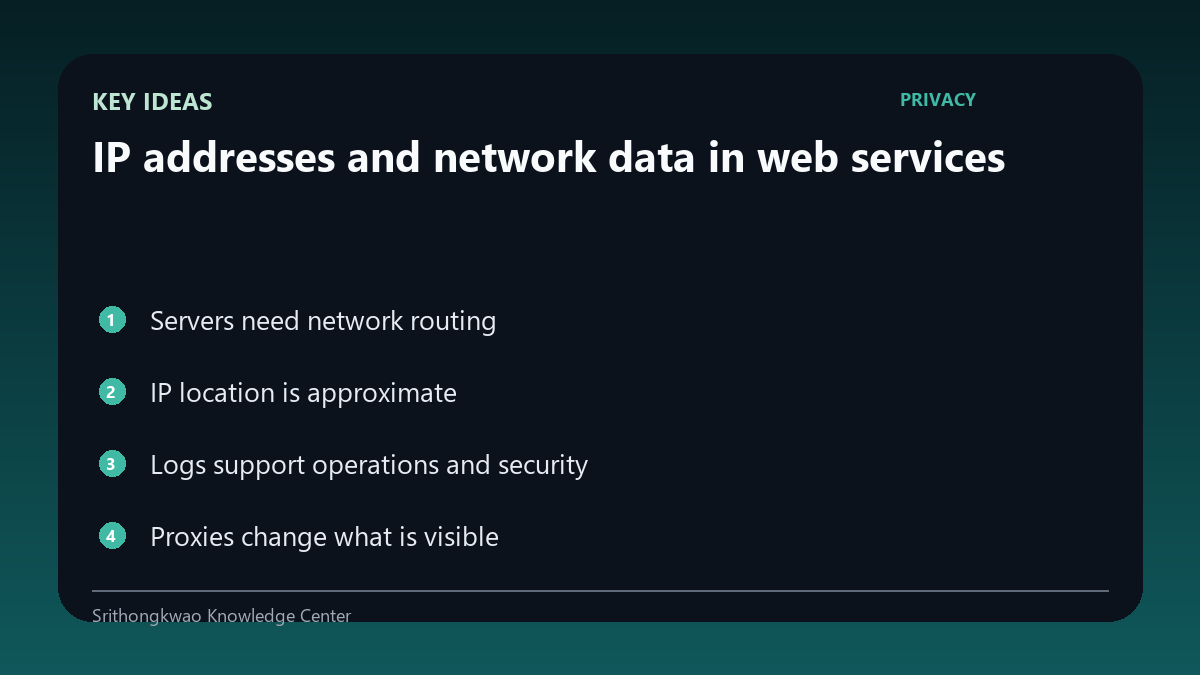
IP location is approximate
IP-based geolocation can indicate a broad region but may be affected by mobile networks, VPNs, corporate gateways and provider routing.
Do not treat an IP estimate as precise physical location.
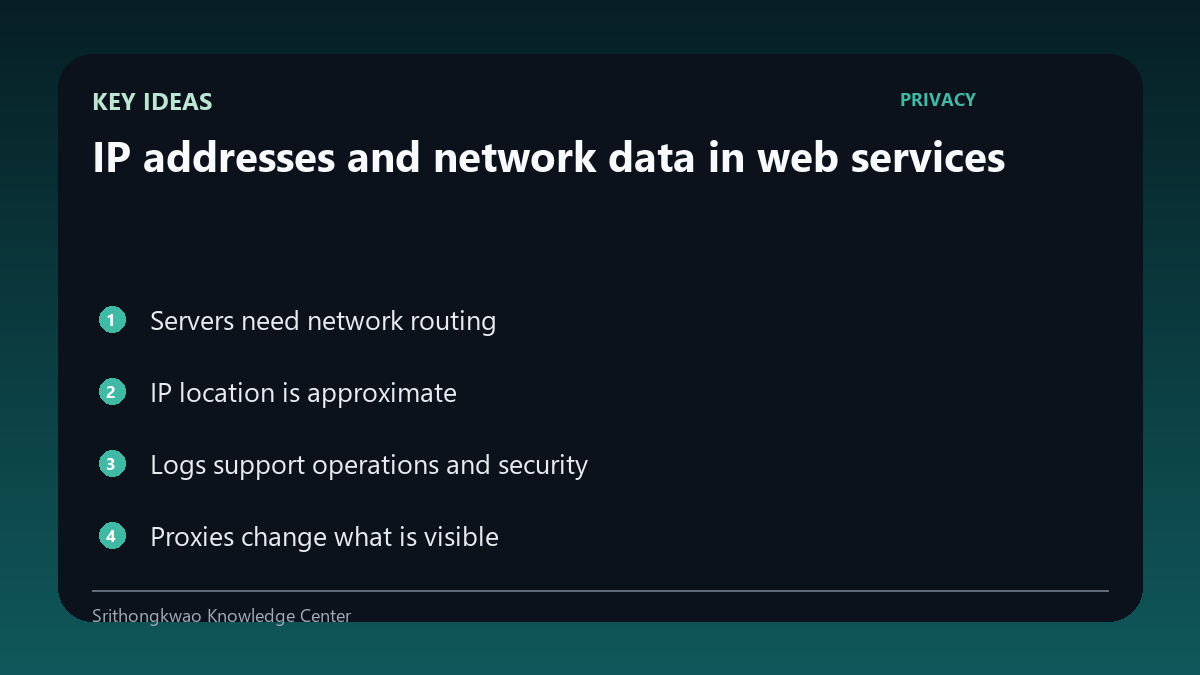
Logs support operations and security
Network logs can help diagnose errors, abuse and service availability.
Retention should be limited according to operational and legal needs rather than kept forever by default.
Proxies change what is visible
A reverse proxy or content-delivery network may sit between the user and application server.
Systems should be configured carefully so trusted forwarding information is interpreted correctly.
Network data should not become a secret profile
Operational logs should not be repurposed casually for unrelated sensitive inference.
Use network information for documented purposes and appropriate security controls.
Common mistakes to avoid
- Calling an IP address an exact street address.
- Keeping logs indefinitely without purpose.
- Using network data for unrelated sensitive profiling.
Practical checklist
- Use logs for defined purposes.
- Limit retention.
- Protect access.
- Treat geolocation as approximate.
- Document third-party network services.
Frequently asked questions
Can an IP reveal my exact home?
Usually it provides much less precise location and can be affected by network routing.
Why does a server log IP information?
It can be part of request routing, security and operational diagnostics.
Can VPN use change the visible IP?
Yes. The service may see the VPN exit network rather than the user's direct connection.