
Traditional context: Why traditions group face shapes is discussed here as part of face reading, palmistry or Feng Shui traditions. Different schools can interpret the same visible feature differently, so the page explains the idea rather than presenting it as a scientific fact.
Responsible-use boundary: Face shape in traditional face reading must not be used to diagnose health, determine lifespan, identify sensitive traits, judge employability or replace professional evidence. The useful role is cultural interest and personal reflection.
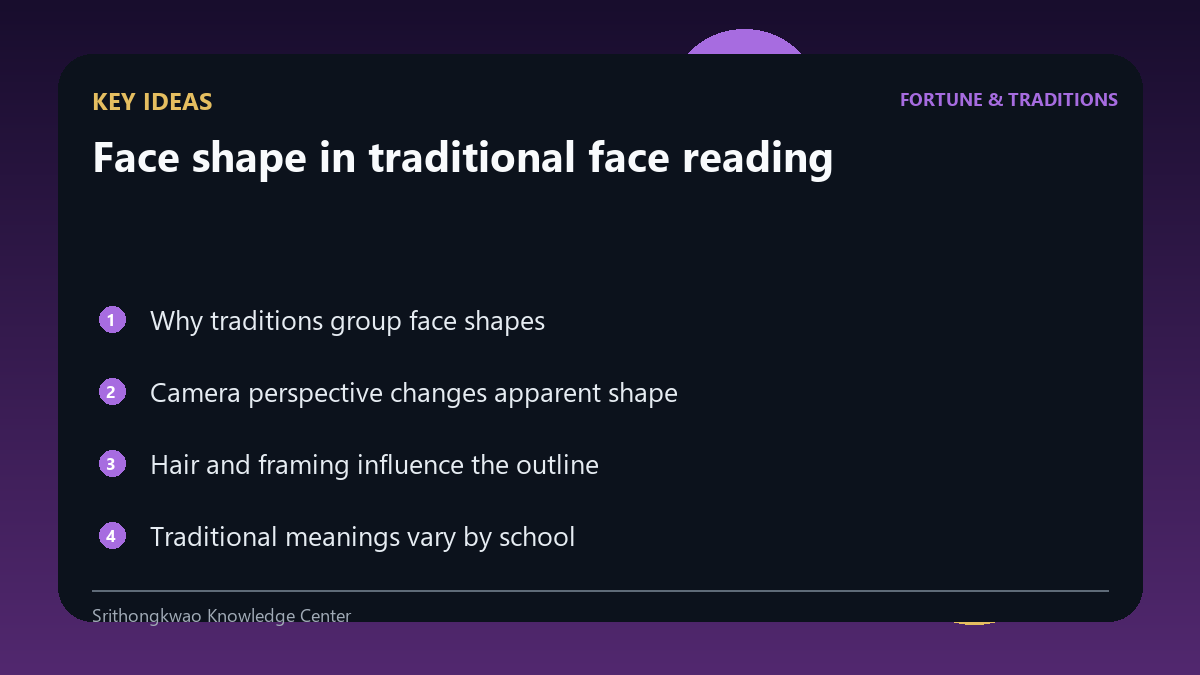
Why traditions group face shapes
Traditional systems often use broad categories such as round, oval, square, long or triangular forms to organize symbolic interpretations. Real faces rarely fit a single geometric label perfectly.
Use the category as a descriptive convenience rather than forcing a person into a rigid box.
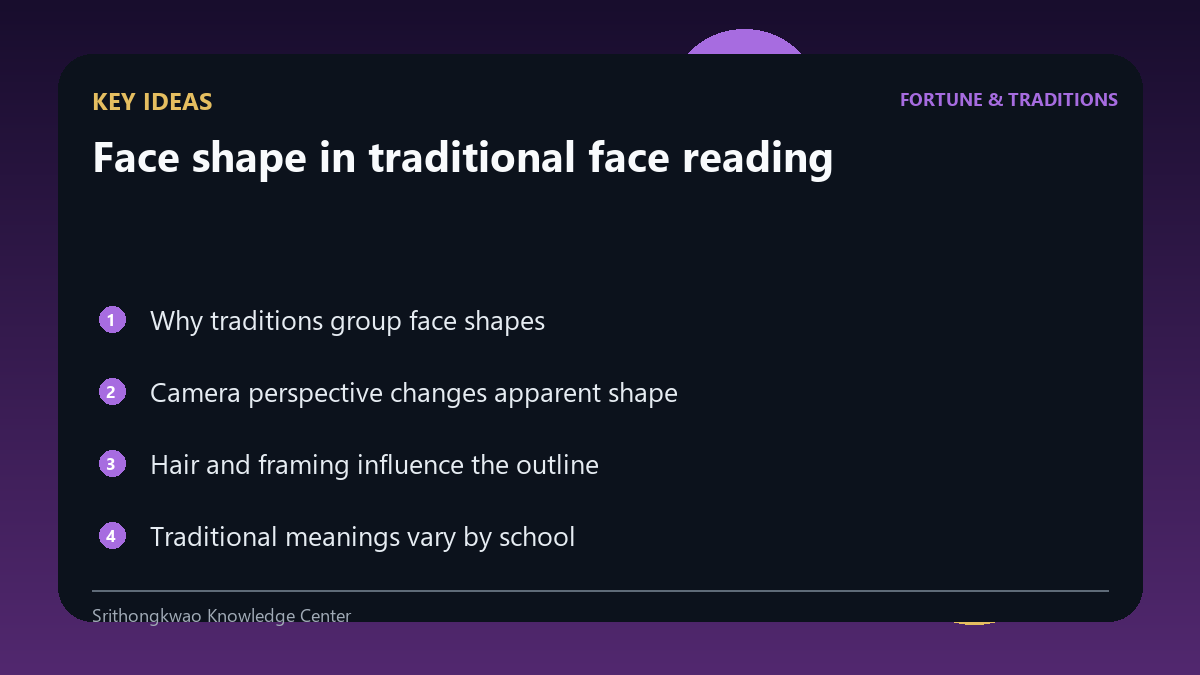
Camera perspective changes apparent shape
A close wide-angle selfie can enlarge central features, while head tilt and camera height can change the apparent jaw and forehead proportions.
A neutral camera distance and angle help preserve the visible outline more naturally.
Hair and framing influence the outline
Hairstyles, headwear and cropped photos can hide the forehead, jaw or side contours that people use when describing overall shape.
When face shape is the topic, include the full facial outline where practical.
Traditional meanings vary by school
One tradition may connect a broad face shape with one symbolic element while another uses a different classification or emphasis.
A responsible article should explain that the association belongs to a tradition and is not a measured psychological fact.
Mixed shapes are normal
Many people show characteristics that could fit more than one traditional category. Human variation does not obey a small set of perfect templates.
Where a category is ambiguous, describe the visible mix instead of pretending the classification is exact.
Common mistakes to avoid
- Forcing every face into one perfect shape.
- Ignoring camera distortion.
- Treating a symbolic category as a personality diagnosis.
Practical checklist
- View the full outline.
- Use a neutral angle.
- Allow mixed categories.
- Compare traditions carefully.
- Keep interpretation symbolic.
Frequently asked questions
Can a face be between two categories?
Yes. Broad traditional categories do not capture every real facial variation.
Does face shape prove personality?
No. Srithongkwao treats those associations as belief-based symbolism.
Why does my face look different in different photos?
Lens distance, angle, expression and lighting can change apparent proportions.