
Traditional context: Expressions move many features at once is discussed here as part of face reading, palmistry or Feng Shui traditions. Different schools can interpret the same visible feature differently, so the page explains the idea rather than presenting it as a scientific fact.
Responsible-use boundary: Facial expression versus visible structure in face reading must not be used to diagnose health, determine lifespan, identify sensitive traits, judge employability or replace professional evidence. The useful role is cultural interest and personal reflection.
Expressions move many features at once
Smiling changes the cheeks, eye opening, mouth corners and sometimes visible jaw shape. Surprise raises brows and changes the forehead.
Recognize the pose before making any description of more stable visible proportions.
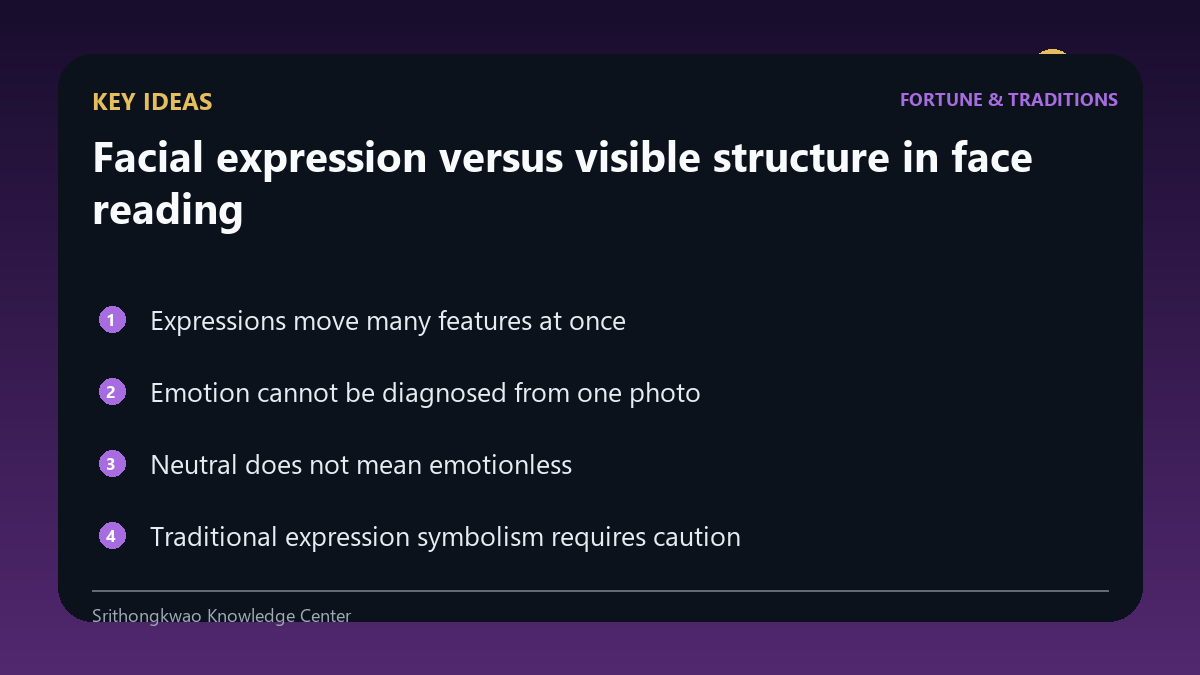
Emotion cannot be diagnosed from one photo
A captured expression may be posed, playful, accidental or influenced by bright light.
Do not use a face-reading feature to declare someone's real emotional state from a single image.
Neutral does not mean emotionless
A neutral image simply reduces extreme facial movement so visible structure is easier to describe.
Users should remain comfortable; there is no need to force an unnatural rigid pose.
Traditional expression symbolism requires caution
Some traditions discuss habitual expression or lines, but a digital system usually has only one or a few images.
Avoid pretending a single photograph reveals long-term behaviour.
Multiple photos can still vary
Even with several images, light, camera distance and timing can change appearance.
Use consistency checks to reduce visual error, not to claim psychological certainty.
Common mistakes to avoid
- Diagnosing emotion from one image.
- Treating a posed smile as permanent structure.
- Forcing an uncomfortable expression.
Practical checklist
- Use a relaxed face.
- Notice temporary movement.
- Avoid emotional diagnosis.
- Compare image conditions.
- Keep symbolism modest.
Frequently asked questions
Can one photo reveal someone's true mood?
No. A photograph captures a moment and can be posed or affected by conditions.
Why do readings prefer a relaxed expression?
It reduces temporary movement that changes visible proportions.
Would several photos prove personality?
No. More images may improve visual context but do not validate personality inference.