How to use this information: What the value represents is most useful when it is read with location, update time and the surrounding forecast rather than treated as an isolated number. For everyday planning, compare the current value with the next few hours. When safety is involved, confirm conditions with the responsible meteorological or public-safety authority.
What not to assume: A consumer forecast simplifies a changing atmosphere. Weather visibility: what the distance can tell drivers and travellers should support a decision, not create false precision about an exact street, exact minute or guaranteed outcome.
What the value represents
Visibility is reported as a distance under observing or forecast conditions. It can be reduced by fog, heavy rain, haze, smoke, dust or other particles and weather effects.
Use the number as an environmental visibility indicator for the selected area, not as a guarantee that every road segment has the same view distance.
Rain can reduce visibility quickly
Intense rain can obscure road markings, vehicles and landmarks even when fog is absent. Spray from traffic can make driving visibility worse than a general weather value suggests.
During heavy rain, respond to the actual road view and official transport advice rather than trying to drive according to the app number.
Fog and low cloud are local
Fog can be highly variable around rivers, low areas, hills and coastlines. Visibility may change over a short distance and over a few minutes.
If travel timing matters, refresh close to departure and look for local official observations or advisories.
Haze and smoke need source-specific information
Reduced visibility can occur from haze or smoke, but a weather visibility value does not identify the health significance or exact source of particles.
For air-quality or wildfire smoke questions, use the responsible environmental or public-health information source.
Direct observation matters most on the road
A driver sees the immediate road environment, which can differ from the nearest weather observation or model grid.
Slow down or change plans according to safe-driving requirements and direct conditions. Weather data is supporting context, not a substitute for seeing the road.
Common mistakes to avoid
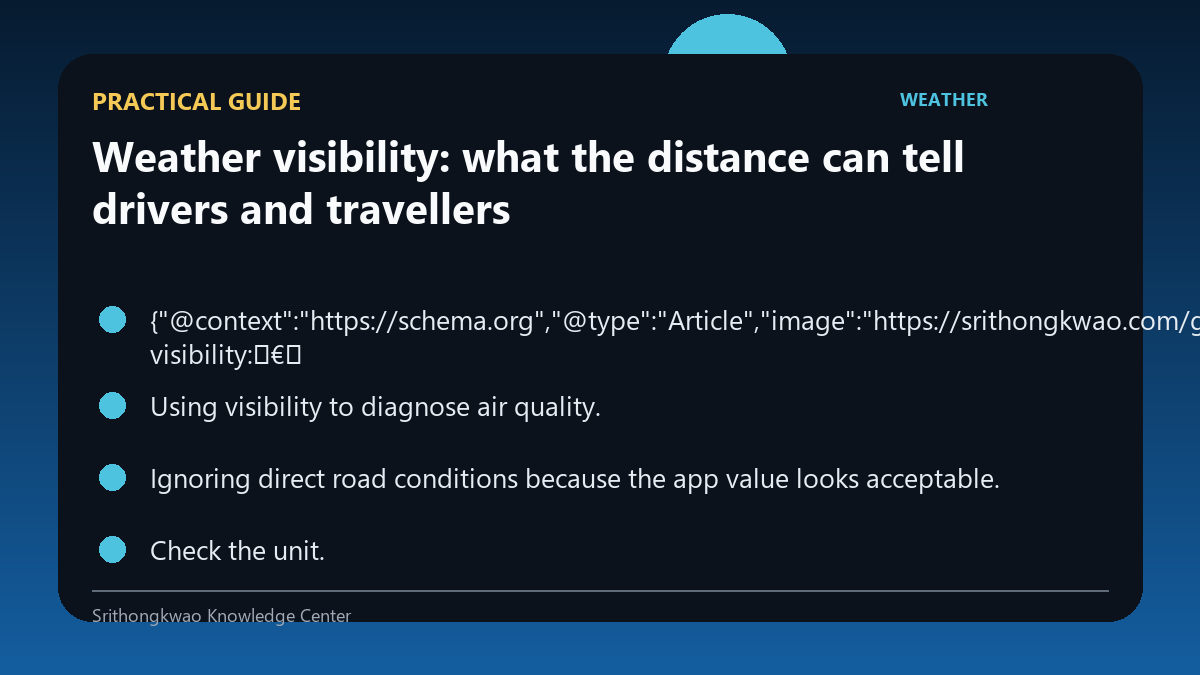
- Assuming one visibility value applies to an entire journey.
- Using visibility to diagnose air quality.
- Ignoring direct road conditions because the app value looks acceptable.
Practical checklist
- Check the unit.
- Refresh before travel.
- Watch rain and fog trends.
- Use air-quality sources for pollution.
- Follow safe-driving and official transport advice.
Frequently asked questions
Why can visibility change suddenly?
Fog, heavy showers, smoke and local terrain can create rapid changes.
Is low visibility always fog?
No. Rain, haze, smoke, dust and other causes can also reduce visibility.
Should drivers use the app number as a speed rule?
No. Follow road law, official advice and the visibility you actually have.