
How to use this information: What a gust value means is most useful when it is read with location, update time and the surrounding forecast rather than treated as an isolated number. For everyday planning, compare the current value with the next few hours. When safety is involved, confirm conditions with the responsible meteorological or public-safety authority.
What not to assume: A consumer forecast simplifies a changing atmosphere. Wind gusts: why brief stronger winds deserve separate attention should support a decision, not create false precision about an exact street, exact minute or guaranteed outcome.
What a gust value means
A gust represents a brief stronger wind within the observing or forecast period. It is not the speed that will blow continuously for the entire hour.
Use gusts to understand the upper end of short-term wind variability rather than replacing the sustained wind value.
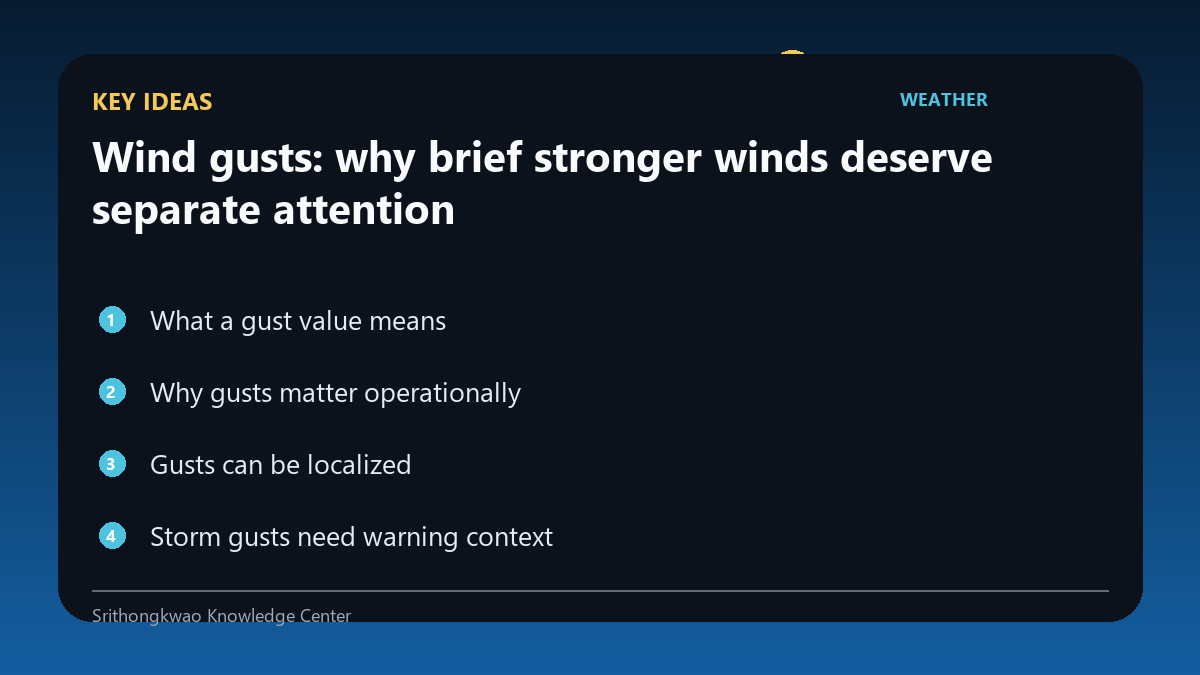
Why gusts matter operationally
Brief stronger winds can move unsecured objects, affect tents or signs, surprise cyclists and influence high-profile vehicles. The effect depends on exposure and the condition of objects or infrastructure.
If your activity is sensitive to sudden force, read the gust forecast explicitly instead of using only average wind.
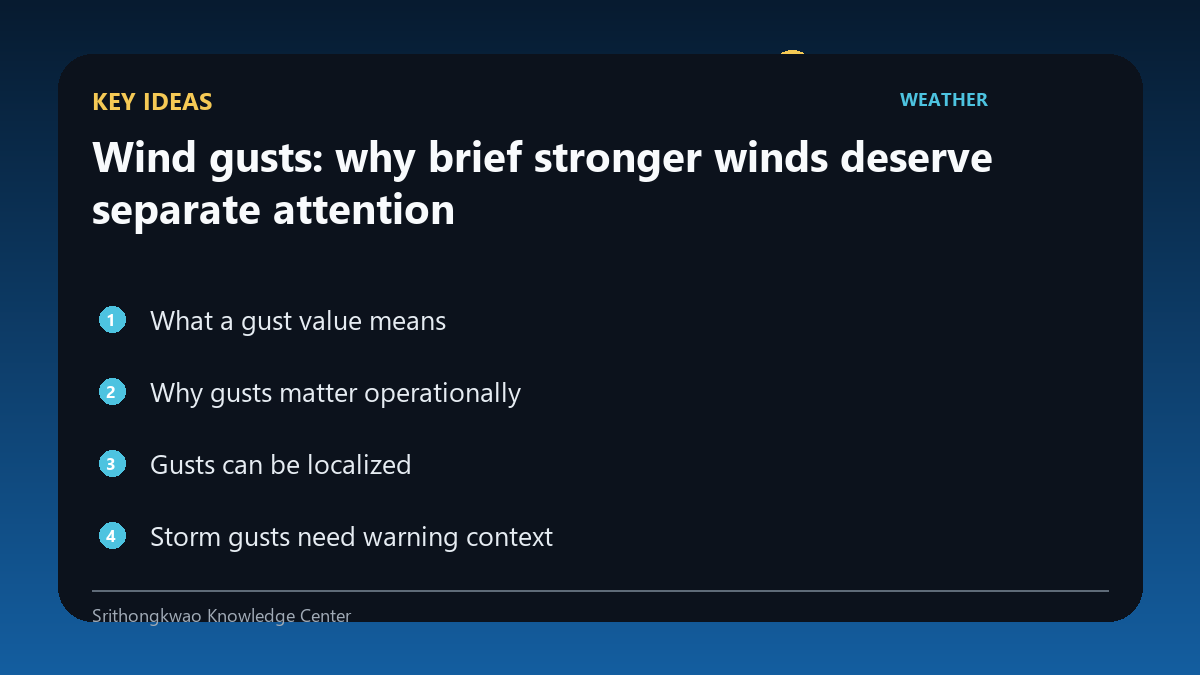
Gusts can be localized
Terrain, showers, thunderstorms and buildings can create short-lived local wind increases. Forecast gusts therefore cannot reproduce every exact street-level peak.
Treat the value as an indicator of variability and remain attentive to real conditions.
Storm gusts need warning context
Thunderstorms can produce rapid wind changes that are more significant than ordinary daytime gustiness. Official severe-weather warnings may describe expected impacts.
During warned severe weather, follow the official message rather than setting your own safety threshold from the app.
Secure before the peak
Outdoor items are easier to secure before wind strengthens. Waiting until gusts are already strong can make preparation more difficult or dangerous.
Use the forecast trend to act early when you have movable objects, temporary equipment or an exposed event setup.
Common mistakes to avoid
- Treating gust speed as a continuous wind.
- Ignoring local exposure.
- Waiting for strong wind to begin before securing loose objects.
Practical checklist
- Compare sustained wind and gusts.
- Check storm warnings.
- Secure loose items early.
- Consider vehicle exposure.
- Monitor real conditions.
Frequently asked questions
Why are gusts higher than the main wind value?
They represent brief stronger bursts above the sustained or average flow.
Do gusts occur continuously?
No. By definition they are short-lived variations.
Can a storm create stronger gusts than forecast?
Actual local storm winds can differ from forecast values, which is why warnings and direct conditions matter.