
Testing practice: For Give testers a real mission, define a reproducible starting state, perform one controlled change at a time and record the result. Good testing evidence helps another person repeat the same path without guessing what happened.
Evidence quality: A useful report separates observation from theory. Record version, device context, steps, expected result and actual result while removing passwords, authentication codes and unrelated personal information from evidence.
Give testers a real mission
Joining a test group is not the same as exercising the app. Provide concrete flows such as account setup, camera use or a key transaction path.
Rotate missions over the test period so activity covers more than the launch screen.
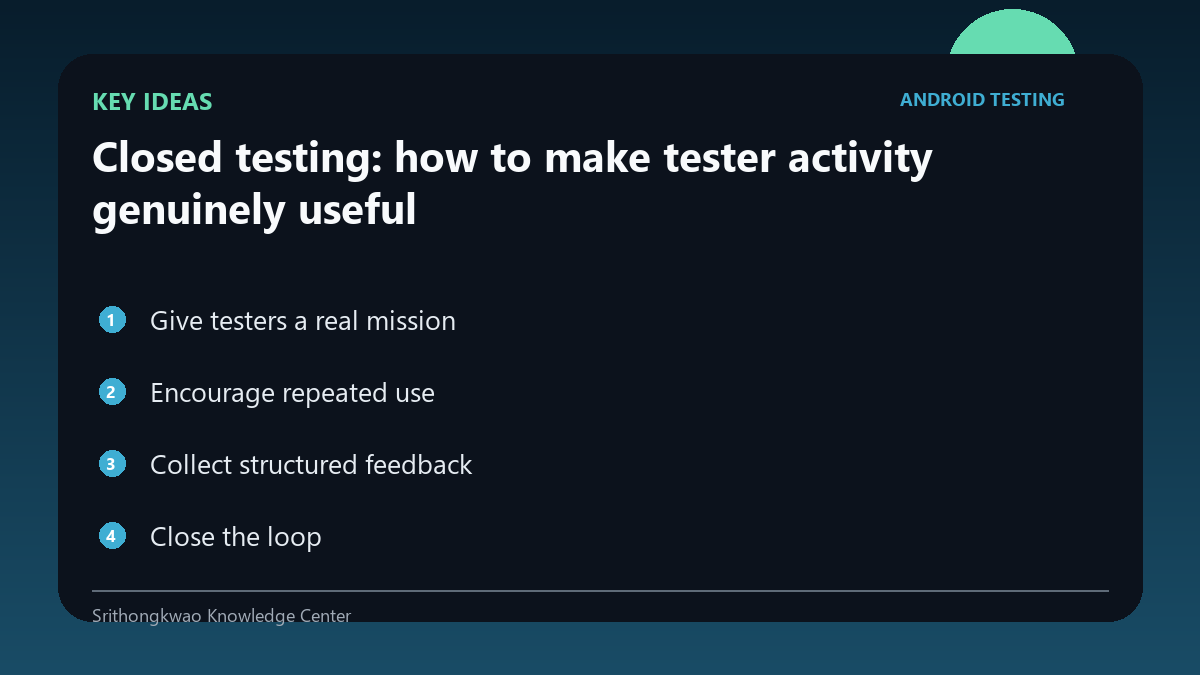
Encourage repeated use
Some problems appear only after updates, restarts, returning sessions or changed permissions.
Ask testers to revisit the app instead of treating testing as a one-time installation.
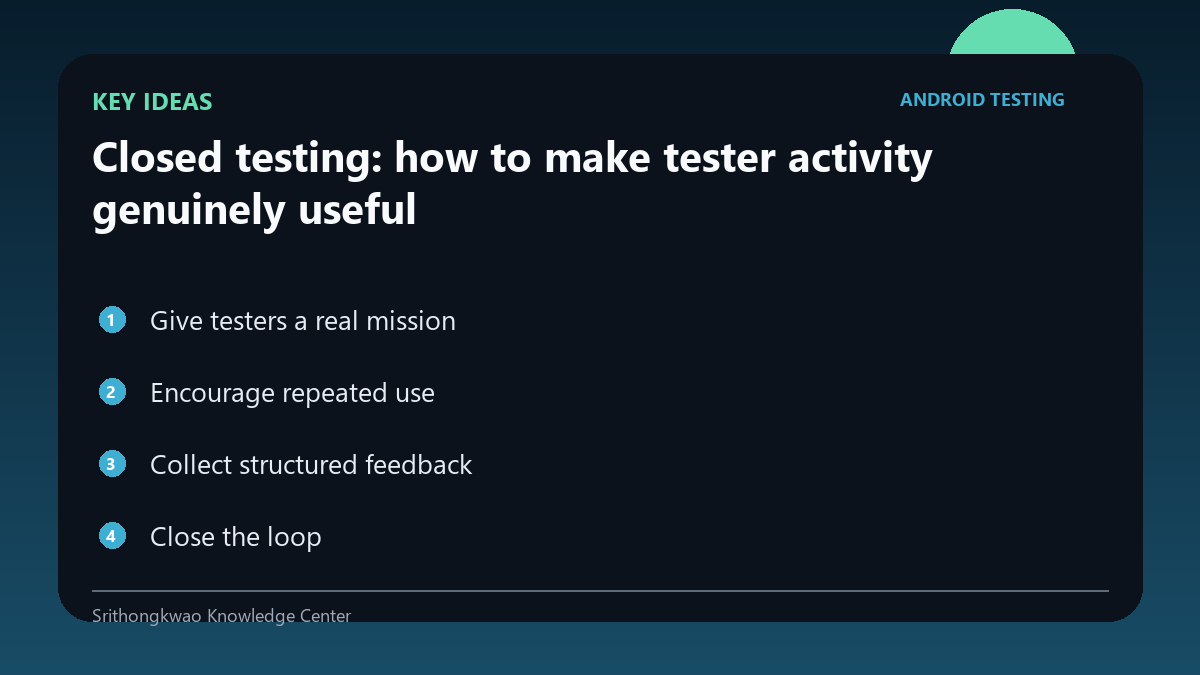
Collect structured feedback
Free-form comments can be useful, but reproducible steps and device context make issues easier to act on.
Provide a simple report format with expected and actual results.
Close the loop
Testing is more credible when reported problems are reviewed, fixed where appropriate and retested.
Track which issue was addressed and which build contains the change.
Keep tester participation authentic
Do not pressure testers to fabricate activity or positive feedback.
The purpose is to learn whether real people can use the product successfully.
Common mistakes to avoid
- Counting enrollment as complete testing.
- Ignoring repeat use.
- Asking for only positive comments.
Practical checklist
- Assign real workflows.
- Encourage repeat sessions.
- Capture structured feedback.
- Retest fixes.
- Keep participation genuine.
Frequently asked questions
Is installation alone enough?
It provides very little product evidence compared with actual workflow use.
Why repeat testing?
State, updates and repeated sessions can expose problems not seen on first launch.
Should testers report negative feedback?
Yes. Useful testing depends on honest observations.