
Traditional context: Breaks may be visual or real is discussed here as part of face reading, palmistry or Feng Shui traditions. Different schools can interpret the same visible feature differently, so the page explains the idea rather than presenting it as a scientific fact.
Responsible-use boundary: Branches, breaks and islands in palmistry lines must not be used to diagnose health, determine lifespan, identify sensitive traits, judge employability or replace professional evidence. The useful role is cultural interest and personal reflection.
Breaks may be visual or real
Shadow, glare or weak focus can make a continuous crease appear interrupted.
Check the original image and nearby frames before naming a break.
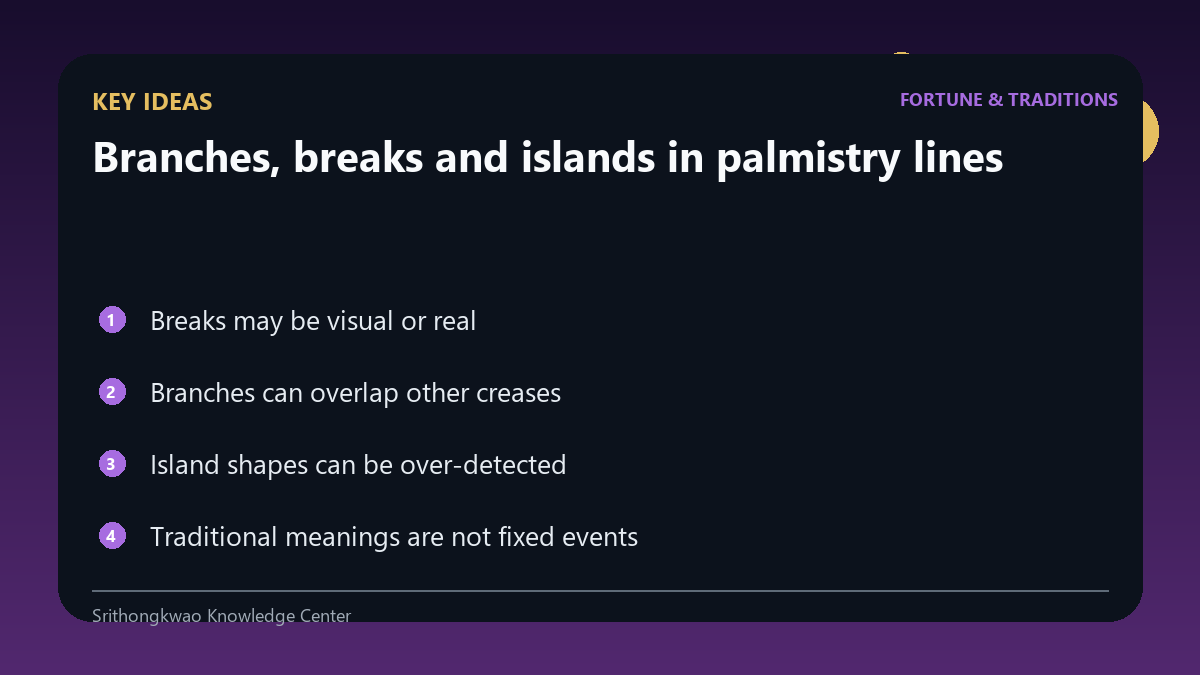
Branches can overlap other creases
A fine line crossing or joining a major line may look like a branch from one angle and a separate crease from another.
Use cautious language such as appears to branch when the image is ambiguous.
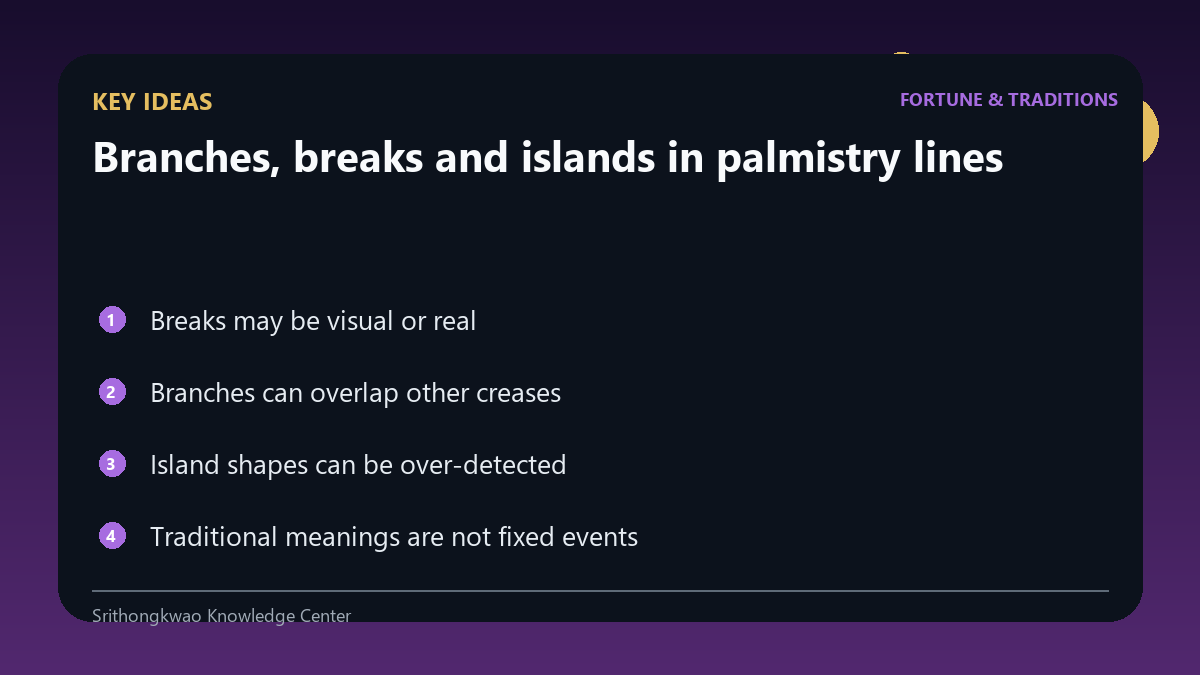
Island shapes can be over-detected
Parallel or crossing fine lines can create an enclosed shape that resembles an island.
Do not force a named pattern when the boundary is incomplete.
Traditional meanings are not fixed events
Some schools connect line changes with transitions, obstacles or shifts.
Those themes should not become predictions of accidents, illness or exact dates.
Comparison between hands may add context
If both hands are photographed under similar conditions, comparing the same region can reduce some image ambiguity.
The comparison remains belief-based and should not be treated as proof of a life event.
Common mistakes to avoid
- Calling a shadow a line break.
- Predicting a specific disaster.
- Forcing an island shape from incomplete lines.
Practical checklist
- Inspect original detail.
- Use cautious wording.
- Compare hands if appropriate.
- Keep meanings broad.
- Avoid event prediction.
Frequently asked questions
Can lighting create a fake break?
Yes. Glare or shadow can hide a section of a crease.
Do branches predict exact events?
No. Traditional interpretations should remain broad and symbolic.
Why compare both hands?
Similar photography can help distinguish persistent visible features from image artifacts.