
Traditional context: Contrast can reveal existing structure is discussed here as part of face reading, palmistry or Feng Shui traditions. Different schools can interpret the same visible feature differently, so the page explains the idea rather than presenting it as a scientific fact.
Responsible-use boundary: Palm image enhancement: clarity without inventing lines must not be used to diagnose health, determine lifespan, identify sensitive traits, judge employability or replace professional evidence. The useful role is cultural interest and personal reflection.
Contrast can reveal existing structure
Moderate local contrast can make faint but real creases easier to distinguish from surrounding skin.
Compare the enhanced image with the original so no interpretation depends only on processed artifacts.
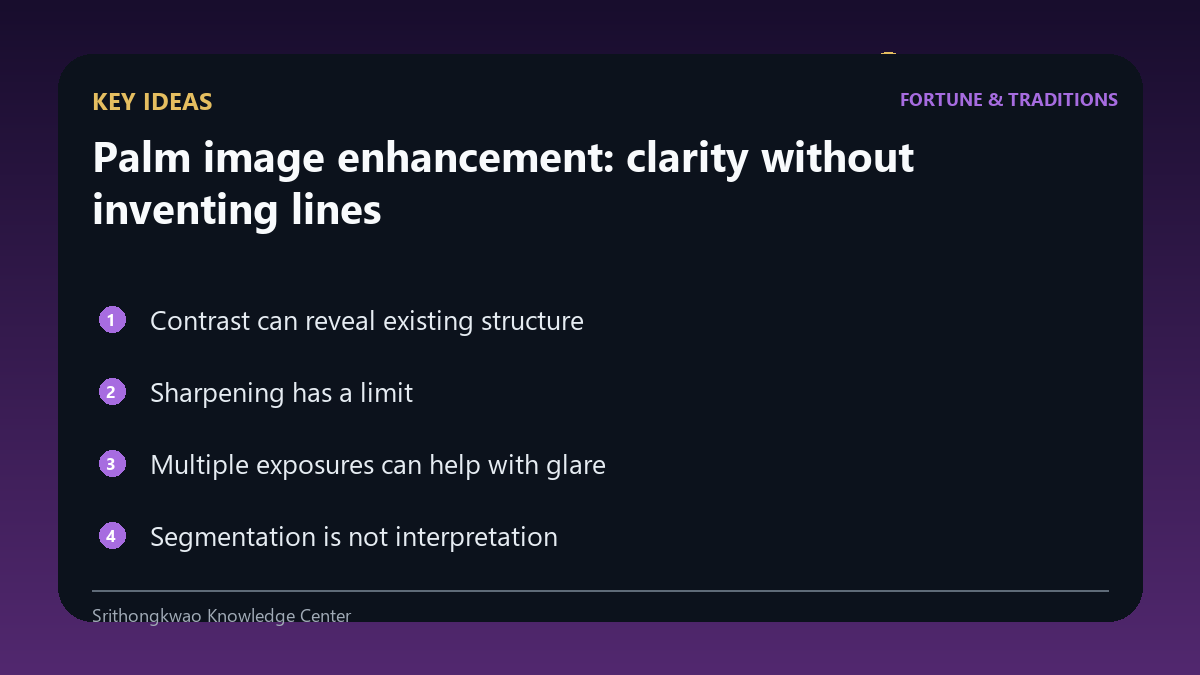
Sharpening has a limit
Edge enhancement increases local differences and can make noise look like tiny lines.
Avoid aggressive settings that produce halos, double edges or connected fragments.
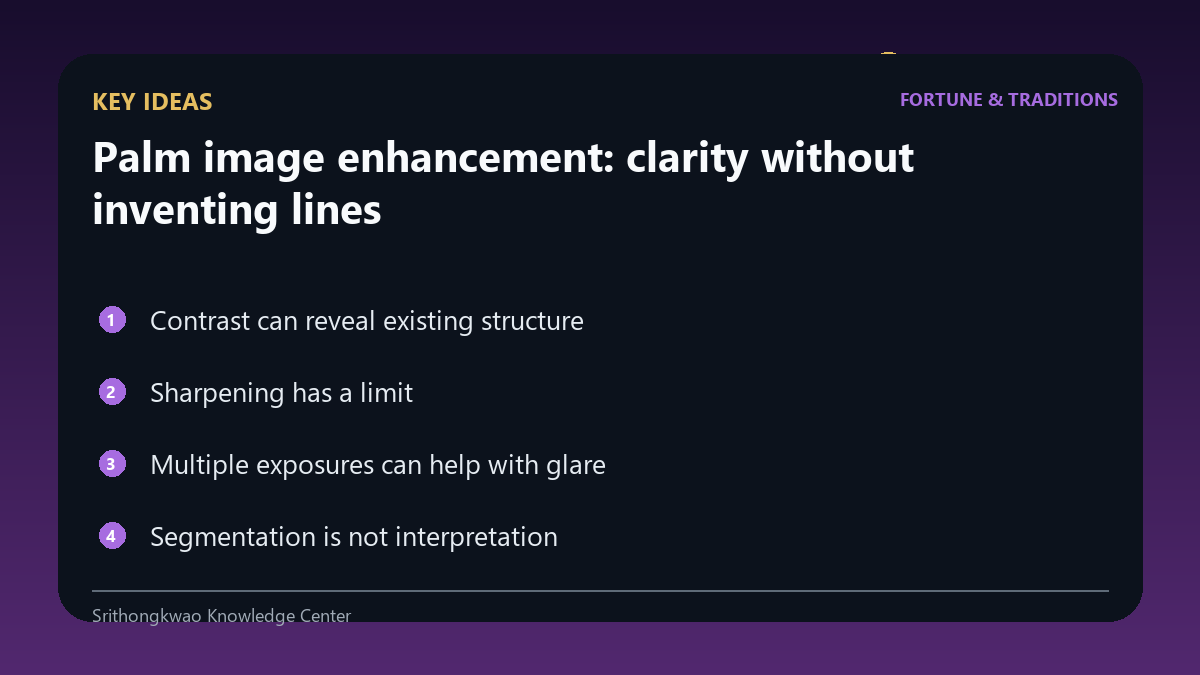
Multiple exposures can help with glare
Images under slightly different light can sometimes preserve detail that one exposure loses to shadow or highlight.
Any combined result should remain traceable to visible information in the source photographs.
Segmentation is not interpretation
Separating the hand from the background can improve processing and framing.
The segmentation step should not be described as scientific proof that a traditional interpretation is accurate.

Original evidence should remain available
A user or reviewer should be able to compare important observations with the unmodified photo.
Keep enhancement as a viewing aid and communicate uncertainty when details remain unclear.
Common mistakes to avoid
- Over-sharpening until new lines appear.
- Discarding the original image context.
- Claiming enhancement makes palmistry scientifically accurate.

Practical checklist
- Keep the original.
- Use moderate contrast.
- Check for halos.
- Treat segmentation as image processing.
- Reject uncertain details.
Frequently asked questions
Can enhancement create false lines?
Yes. Aggressive sharpening and contrast can turn noise into line-like artifacts.
Does a clearer photo prove the reading?
No. It only improves visibility of the image used by a belief-based interpretation.
Why preserve the original?
It allows important observations to be checked against unprocessed evidence.