
Traditional context: Use even, ordinary lighting is discussed here as part of face reading, palmistry or Feng Shui traditions. Different schools can interpret the same visible feature differently, so the page explains the idea rather than presenting it as a scientific fact.
Responsible-use boundary: Preparing a photo for a face-reading experience must not be used to diagnose health, determine lifespan, identify sensitive traits, judge employability or replace professional evidence. The useful role is cultural interest and personal reflection.
Use even, ordinary lighting
Strong backlight can turn the face into shadow, while a small harsh light can create deep contrast on one side. Soft, even light reveals the visible outline and features more consistently.
Stand near diffuse daylight or use normal room lighting rather than trying to create a dramatic portrait.
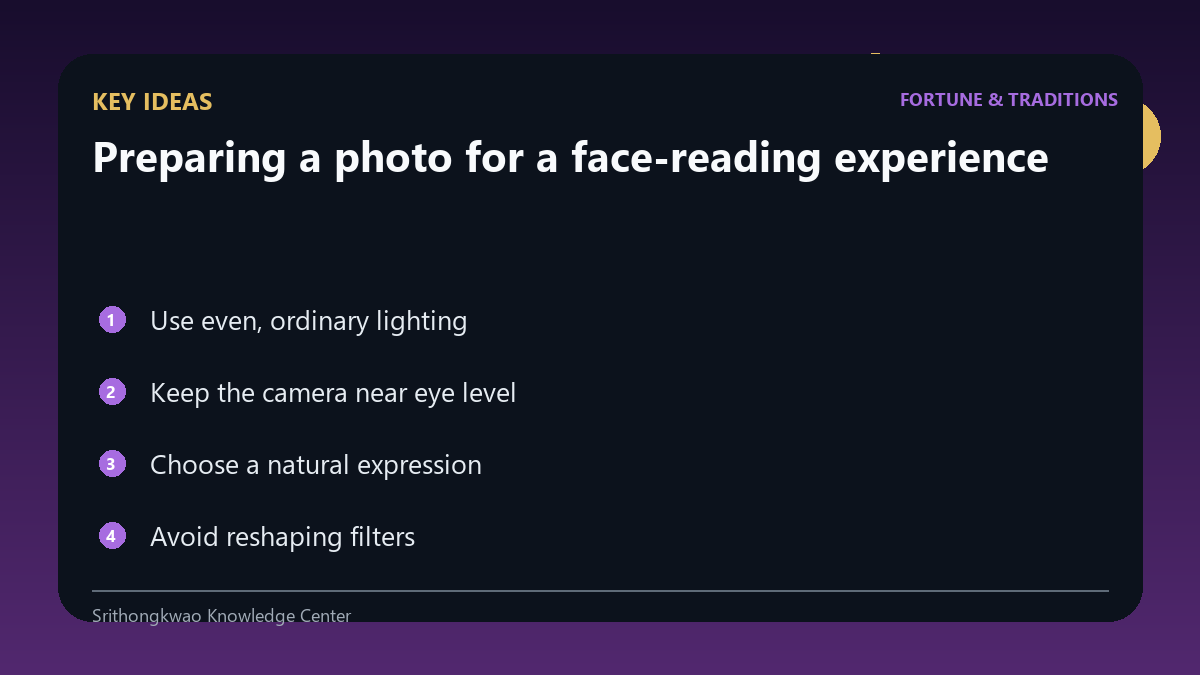
Keep the camera near eye level
Very high, low or close wide-angle selfies can exaggerate some proportions and compress others. The effect can be visually attractive but less neutral for feature comparison.
Hold the camera at a comfortable distance and keep the face reasonably centered.
Choose a natural expression
An extreme smile, squint or pose can change the apparent shape of cheeks, eyes, lips and jaw.
A relaxed expression gives a simpler baseline when the feature is intended to discuss visible structure.
Avoid reshaping filters
Beauty filters can alter eye size, jaw contour, nose shape, skin texture and other visible characteristics.
Disable face-changing filters and avoid aggressive retouching before submitting an image.
Protect the background
A face photo can accidentally include other people, documents, screens, addresses or mirrors that reveal private surroundings.
Review the full frame and remove unrelated personal information before upload.
Common mistakes to avoid
- Using an extreme selfie angle.
- Applying a face-shaping beauty filter.
- Forgetting private information in the background.
Practical checklist
- Use even light.
- Keep the camera stable.
- Use a relaxed expression.
- Disable reshaping filters.
- Review the background before upload.
Frequently asked questions
Does better lighting make the reading more accurate scientifically?
No. It only makes visible features easier for the digital experience to see.
Can I use a heavily edited portrait?
A natural image is preferable because editing can change the very features the experience discusses.
Why should I check the background?
Images can reveal unrelated people, documents or private surroundings.