Traditional context: Dominant hand usually means the hand used most is discussed here as part of face reading, palmistry or Feng Shui traditions. Different schools can interpret the same visible feature differently, so the page explains the idea rather than presenting it as a scientific fact.
Responsible-use boundary: Dominant and non-dominant hands in palmistry traditions must not be used to diagnose health, determine lifespan, identify sensitive traits, judge employability or replace professional evidence. The useful role is cultural interest and personal reflection.
Dominant hand usually means the hand used most
For many people the dominant hand is the one used for writing and fine tasks, though dominance can be mixed or task-specific.
Ask the user rather than guessing from a photograph.
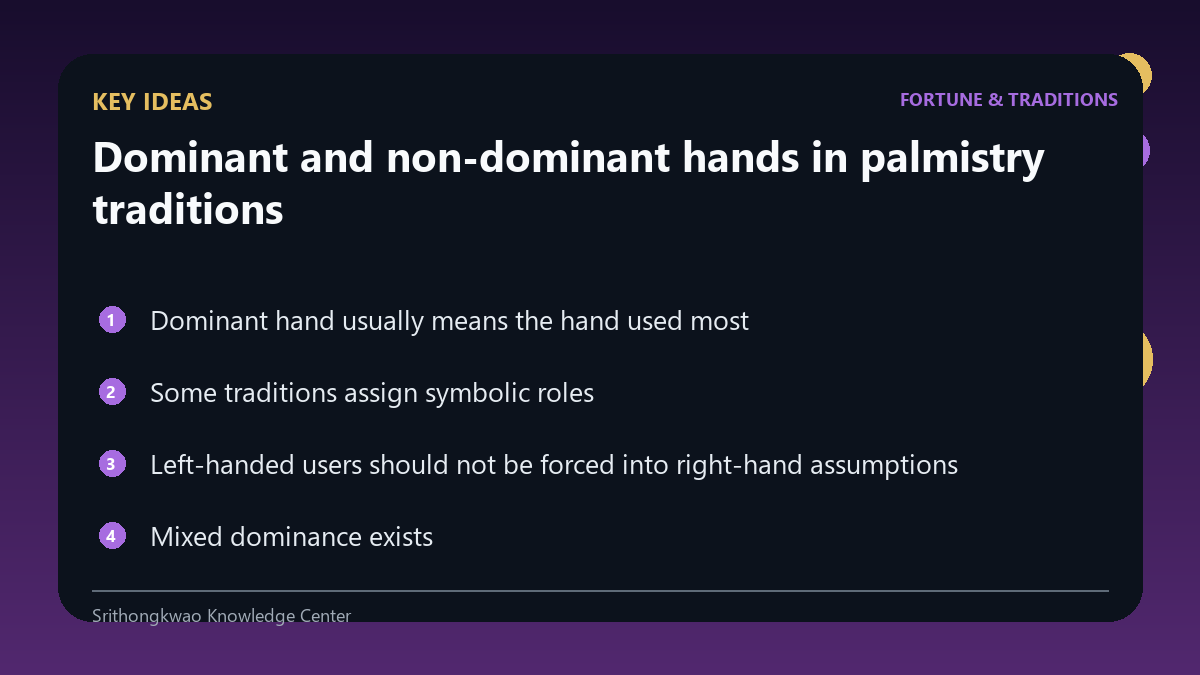
Some traditions assign symbolic roles
Certain palmistry schools treat the dominant hand as reflecting developed patterns and the non-dominant hand as inherited or underlying tendencies. Other systems use left and right rules instead.
Describe the convention as traditional symbolism, not as a biological fact.
Left-handed users should not be forced into right-hand assumptions
A fixed rule that always treats the right hand as dominant can mislabel left-handed users.
Store or request handedness explicitly when the interpretation depends on it.
Mixed dominance exists
A person may write with one hand but perform other tasks with the other.
Allow the user to state mixed or uncertain dominance rather than inventing certainty.
Comparison is about symbolism, not proof
Differences between the two palms are normal and can be emphasized by image quality.
Use comparison for traditional narrative while avoiding claims that one hand proves a hidden factual trait.
Common mistakes to avoid
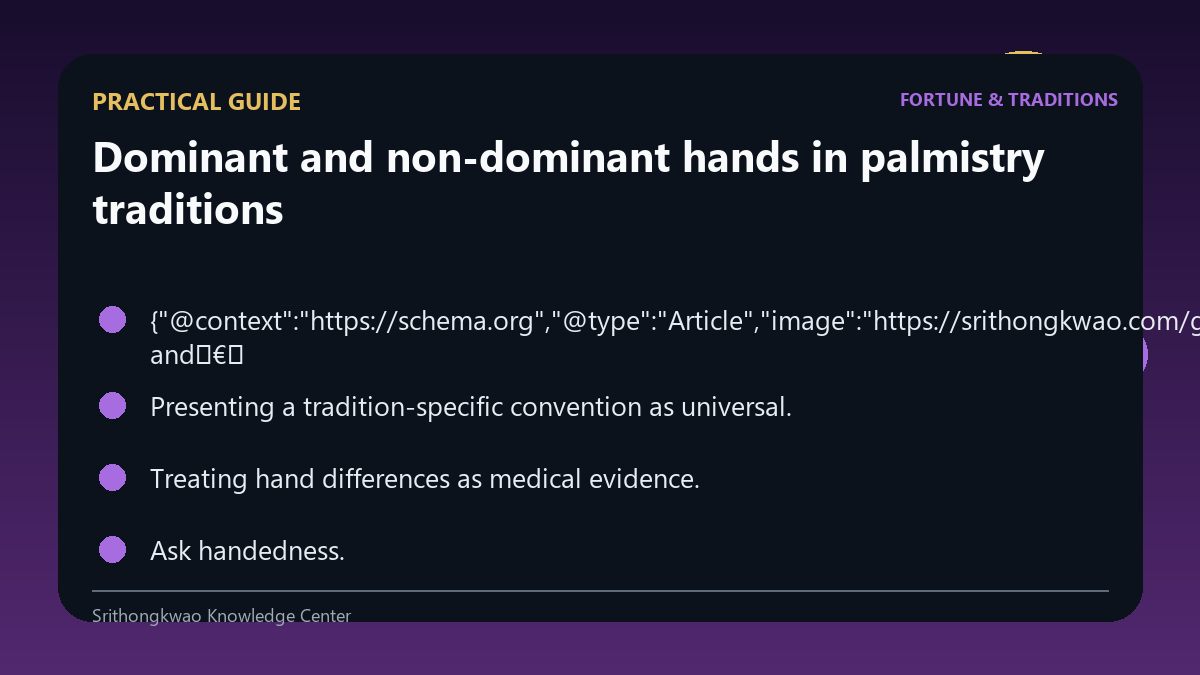
- Assuming everyone is right-handed.
- Presenting a tradition-specific convention as universal.
- Treating hand differences as medical evidence.
Practical checklist
- Ask handedness.
- Label each photo.
- Explain the convention.
- Allow mixed dominance.
- Keep comparison symbolic.
Frequently asked questions
Is the right hand always the active hand?
No. Dominance varies by person and some traditions use different conventions.
What if I use different hands for different tasks?
The reading should allow mixed dominance or explain how it chooses a convention.
Do palm differences prove personality change?
No. Palmistry interpretations are belief-based rather than scientific proof.