
Traditional context: Visibility is often incomplete is discussed here as part of face reading, palmistry or Feng Shui traditions. Different schools can interpret the same visible feature differently, so the page explains the idea rather than presenting it as a scientific fact.
Responsible-use boundary: Ears in traditional face reading must not be used to diagnose health, determine lifespan, identify sensitive traits, judge employability or replace professional evidence. The useful role is cultural interest and personal reflection.
Visibility is often incomplete
Hair, headwear, headphones and side angle can hide one or both ears.
If the ears are not clearly visible, the reading should state the limitation rather than inventing detail.
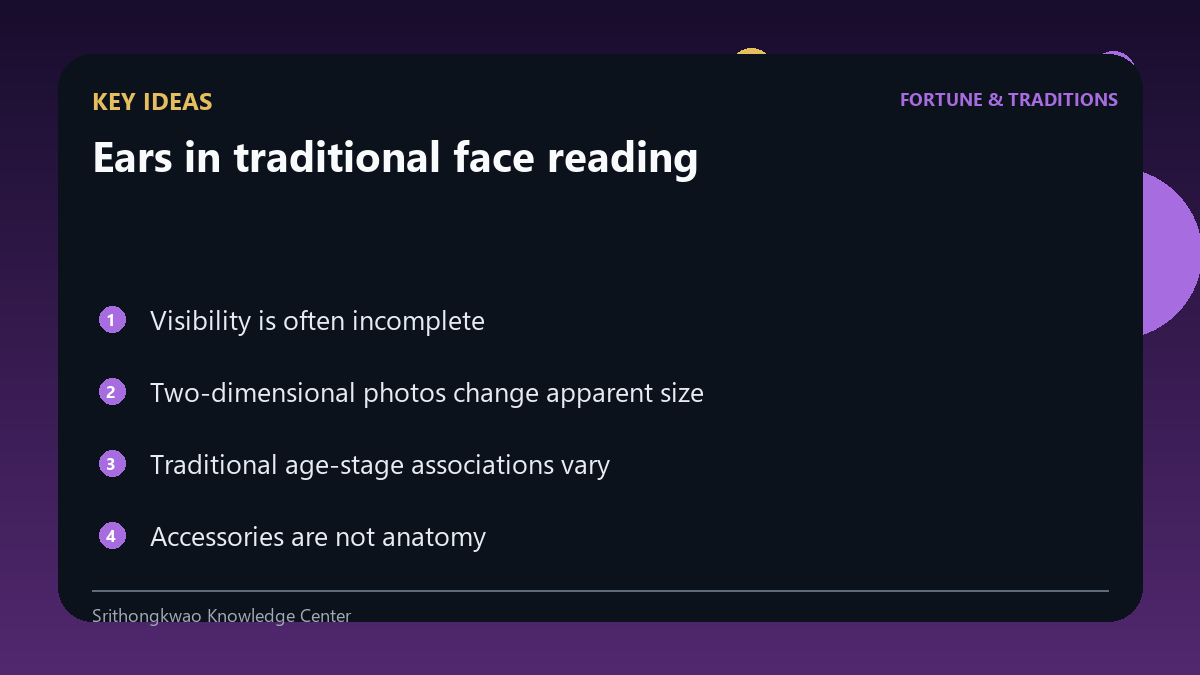
Two-dimensional photos change apparent size
An ear farther from the camera can appear smaller, especially when the head is rotated.
A front-facing image helps compare placement but may still not show every contour.
Traditional age-stage associations vary
Some systems connect ears with early-life or inherited symbolism, while others emphasize shape or placement differently.
These ideas should be presented as tradition-specific rather than universal rules.
Accessories are not anatomy
Earrings and other accessories can draw attention or alter the visual outline.
Do not confuse decoration with the underlying visible ear shape.
No health conclusions
Ear shape, colour or asymmetry should not be used to diagnose hearing, circulation or disease.
Medical concerns belong with qualified health professionals.
Common mistakes to avoid
- Inventing detail when hair covers the ears.
- Comparing two ears from a strongly rotated head.
- Making hearing or health claims.
Practical checklist
- Check whether both ears are visible.
- Note accessories.
- Use neutral head position.
- Label symbolism as traditional.
- Avoid health conclusions.
Frequently asked questions
What if one ear is hidden?
The reading should acknowledge that the feature cannot be assessed reliably from that image.
Can ear shape diagnose hearing?
No. A face-reading experience is not a medical assessment.
Why can ears look different in photos?
Head rotation and lens perspective can change apparent size and position.