Separate 'now' from 'later'
Current conditions describe the latest available observation or model-derived current state for the selected location. A forecast describes an expected future state. They belong on the same screen because users need both, but they should not be read as the same kind of statement. If you are deciding whether to leave home now, give current conditions and very near-term information more weight than a forecast many hours away.
Always check the selected location
A precise forecast for the wrong place is still the wrong forecast for you. Confirm the city or location shown by the product, especially after travelling or changing device permissions. Weather can differ across short distances because of terrain, coastline, urban surfaces and local storms.
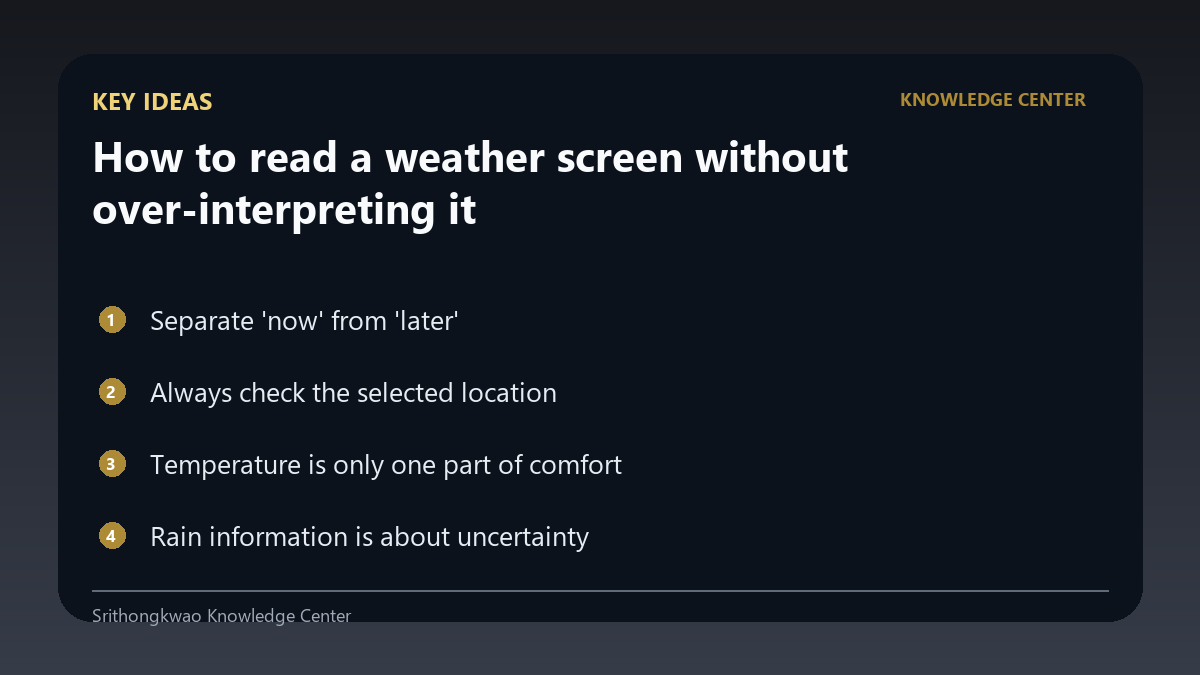
Temperature is only one part of comfort
Air temperature is easy to compare, but wind, humidity, sunlight and rain can change how conditions feel. Use the available supporting information rather than making a decision from one number alone. If the product shows a 'feels like' value, remember that it is an estimate based on a formula, not a direct measurement of how every person will feel.
Rain information is about uncertainty
Forecast rain indicators should be read as guidance, not as a promise that rain will begin at an exact minute at your exact position. Convective showers can be especially local. When rain would seriously affect your plans, check the hourly sequence and refresh before departure rather than relying on a screenshot taken earlier.
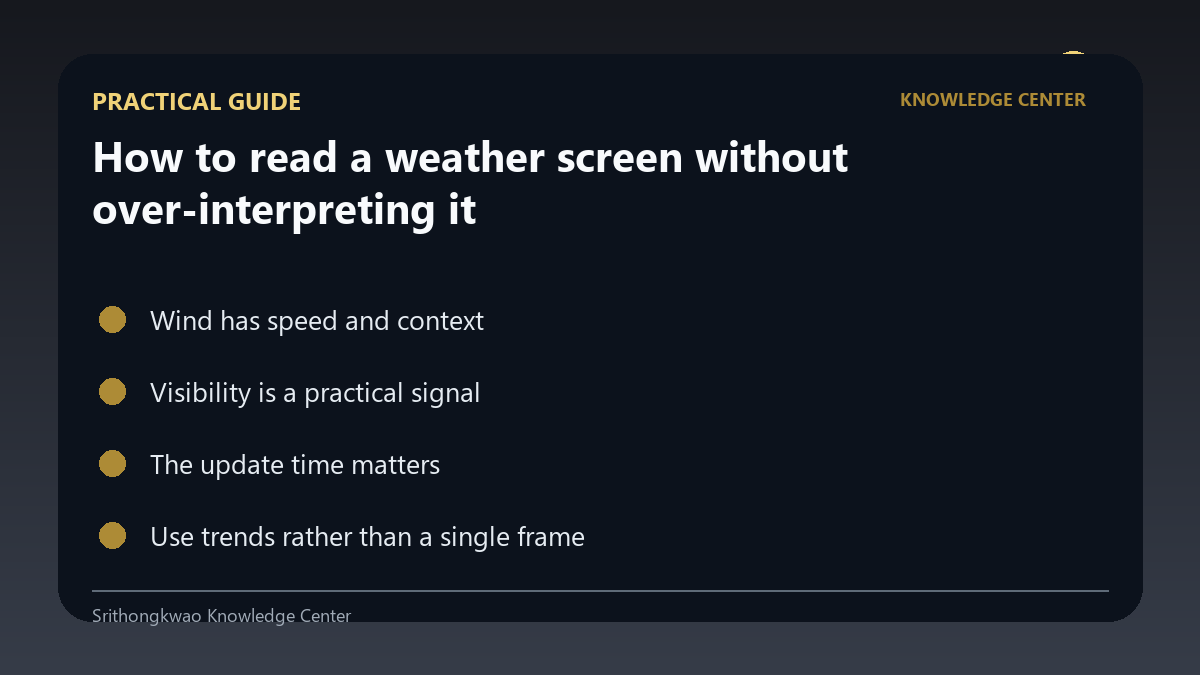
Wind has speed and context
Wind information is most useful when you consider both the value and what you are doing. A breeze that is unimportant for a short walk may matter more for boating, outdoor structures or high-profile vehicles. The app can help you notice changing conditions, but activity-specific safety limits should come from the relevant authority or operator.
Visibility is a practical signal
Reduced visibility can be associated with rain, mist, smoke, haze or other conditions. Treat a low value as a cue to look at the complete situation rather than assuming one cause. Drivers should use direct road visibility and official transport advice as the primary safety reference.
The update time matters
Weather changes. A beautifully designed card can still be stale if the network has been unavailable or the page has remained open for a long time. Look for the update time where available and refresh when conditions are developing quickly. Reconnecting to current data is more useful than repeatedly interpreting an old value.
Use trends rather than a single frame
An hourly timeline is valuable because it shows direction: warming or cooling, increasing rain risk, strengthening wind or improving visibility. A trend can be more informative than one isolated value. When two adjacent hours differ sharply, treat that as uncertainty worth monitoring rather than a precise boundary in the sky.
Weather information is decision support, not emergency authority
Srithongkwao Weather is designed to make weather information easier to understand. It is not an emergency warning authority. During severe weather, floods, tropical systems or other hazards, follow official warnings and instructions from the responsible local agencies.