
Traditional context: Resting shape and expression differ is discussed here as part of face reading, palmistry or Feng Shui traditions. Different schools can interpret the same visible feature differently, so the page explains the idea rather than presenting it as a scientific fact.
Responsible-use boundary: The mouth and lips in traditional face reading must not be used to diagnose health, determine lifespan, identify sensitive traits, judge employability or replace professional evidence. The useful role is cultural interest and personal reflection.
Resting shape and expression differ
Smiling, speaking or pressing the lips changes the visible contour and corner position.
A relaxed closed-mouth or comfortable neutral expression provides a simpler baseline for structural description.
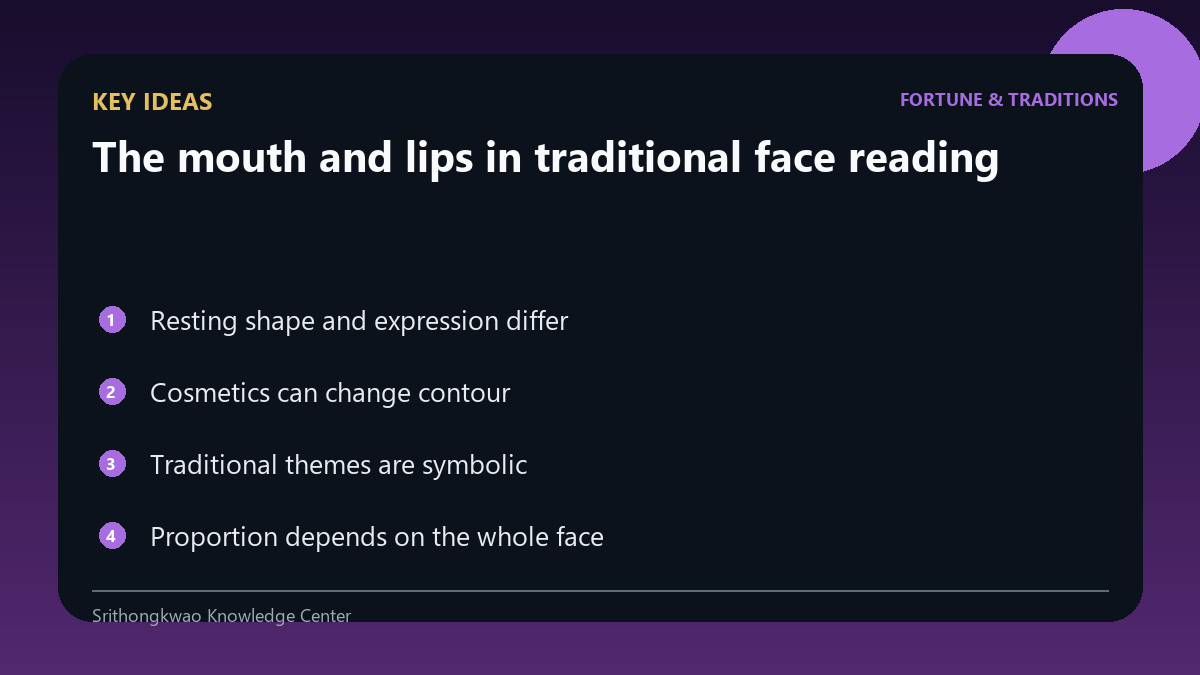
Cosmetics can change contour
Lip liner, lipstick and image filters can make the lips appear fuller, narrower or differently shaped.
Acknowledge visible cosmetic styling rather than assuming every contour is natural.
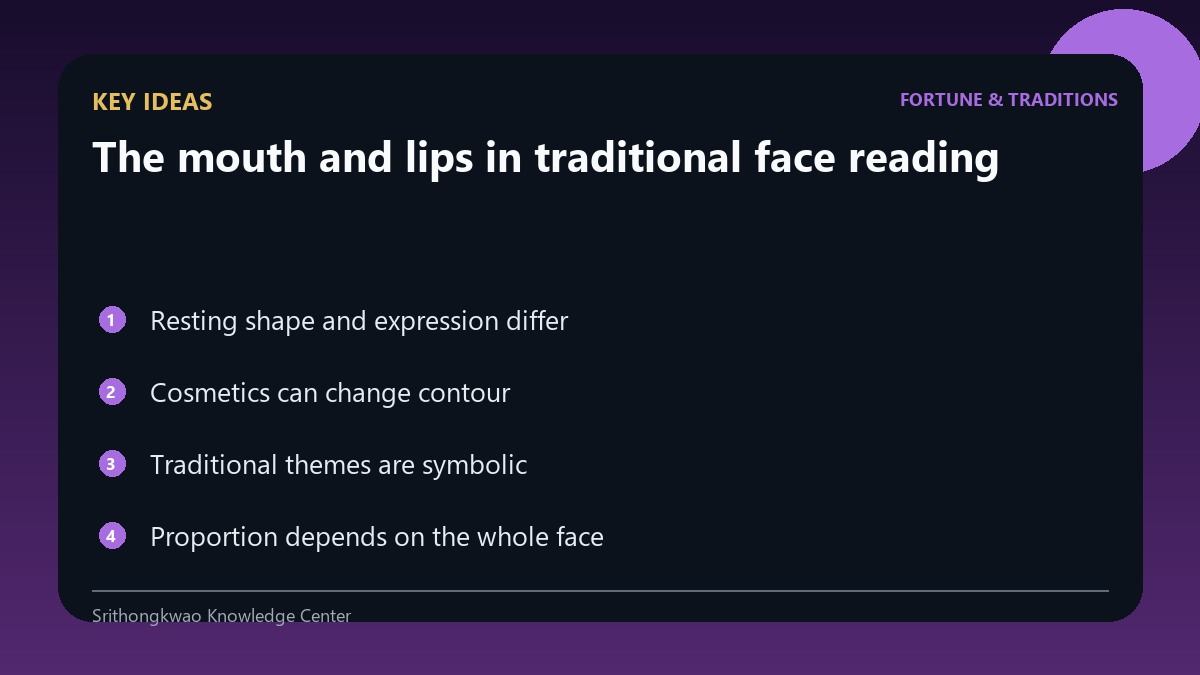
Traditional themes are symbolic
Some traditions connect mouth or lip forms with communication, relationships or generosity. These are belief-based associations.
Do not turn those themes into factual judgments about fidelity, kindness, morality or relationship suitability.
Proportion depends on the whole face
The mouth may appear wide or narrow partly because of nearby facial proportions and lens perspective.
Describe the feature in context rather than assigning meaning to an isolated measurement.
Avoid sensitive conclusions
Appearance cannot establish sexual history, orientation, emotional stability or other sensitive personal information.
Keep interpretations within cultural symbolism and reflective entertainment.
Common mistakes to avoid
- Reading a smile as permanent structure.
- Using lip shape to judge morality or relationships factually.
- Ignoring makeup and filters.
Practical checklist
- Use a relaxed expression.
- Note cosmetic effects.
- Describe proportions in context.
- Keep relationship themes symbolic.
- Avoid sensitive inference.
Frequently asked questions
Can lipstick affect the reading?
Yes. Cosmetics can change the visible contour and apparent fullness.
Can lip shape prove relationship behaviour?
No. Traditional associations are not factual evidence about a person's relationships.
Why should the mouth be relaxed?
Speech and expression temporarily change its visible form.